Arcana 8 in a child’s matrix
A child guided by a sense of fairness, who grows in confidence around adults who keep their word and explain their rules.
- explained rules
- word kept
- trust earned
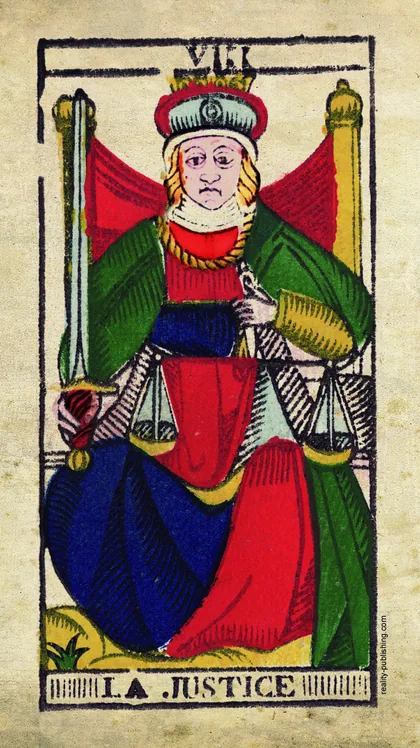
Arcana 8 in a child’s matrix at a glance
Your child shows an early sense of right and wrong: they own up to a mistake when asked calmly, share without being pushed, and speak up when a younger child is left out. They quickly buy into a rule whose meaning they grasp. Welcomed with respect, this inner compass can become real strength of character.
The parenting pitfall is inconsistency: a rule applied one day and forgotten the next, a brother or sister handled differently without explanation, a promise not kept. These gaps hurt your child more than firmness does. Also avoid making them the judge of the household: it is not their job to referee adult conflicts.
- The card
- VIII · Justice
- The position
- A child’s matrix
By Thomas Guilhot · updated
Their character
The child who carries the 8 has a keen sense of fair and unfair.
They notice at once that a sibling got a bigger slice of cake, that a classmate cheated at the game, that a rule was not applied to everyone. They ask many questions about why things are the way they are and want to understand the reasons for a ban before accepting it. Reliable, they put away their things, respect schedules, and remember every promise made to them, especially if it was not kept. An injustice experienced at home or at school can mark them for a long time and make them distrustful or quick to anger. They need consistent adults, clear rules that are the same for everyone, explanations rather than orders. What helps them thrive: being given responsibilities sized to them, such as feeding the family pet or managing a little pocket money.
Advice for parents
- Keep every promise made, or honestly explain why it cannot be kept
- Apply the same rules to all the children in the family
- Explain the reason for a consequence and make it proportionate to the fault
- Never shame them or talk about their mistakes in front of other people
- Give them a regular responsibility, like the plants or the mail
- Play rule-based games with them: chess, board games, mysteries
- Take them to help a charity or a neighbor, simply to do good
- Each evening, look with them for what went well during the day
Girl or boy
In a girl, the 8 often shows in organization and a quiet authority over younger children. In a boy, it more readily takes the form of challenge, competition, and the wish to be in charge.
With others
In the schoolyard, the 8 child often plays the referee: they recall the rules of the game, defend the one being pushed around, and go find the supervisor when a situation seems unfair to them.
Teachers describe them as serious, logical, punctual, sometimes argumentative. They work well when instructions are precise and grades are justified; an assessment they judge arbitrary can make them lose all motivation in the subject. Their difficulty: taking sides too quickly in a dispute, or holding a grudge for a long time against a classmate who betrayed them. Help them hear both versions, accept that one does not always win, and settle a disagreement through words rather than punishment.
In everyday life
One evening you announce that screen time ends earlier than planned.
Your child protests: “Yesterday we said half an hour!” It is true, you did promise. Simply acknowledge it, then explain what is different tonight and why. If there is no real reason, keep the promise. Your child learns that rules apply to adults too, and accepts the ones that cost them all the more readily.
A symbolic reading to better understand a child: never a diagnosis or a label; a childhood professional remains the reference.
Go further
Justice
The card of energy 8Arcana 8 in the portrait
The same energy, in another position of the matrixPortrait 8 and its twelve talents
The same energy, in another position of the matrixArcana 8 in your personal brand
The same energy, in another position of the matrixArcana 8 in the couple matrix
The same energy, in another position of the matrix
How is it calculated?
Nothing changes compared with an adult’s matrix.
Fictional example: a child born on March 14, 2018. The day gives a = 14; the month gives b = 3; the year gives 2 + 0 + 1 + 8 = 11, so c = 11. The lesson d = 14 + 3 + 11 = 28, reduced to 10. The center e = 14 + 3 + 11 + 10 = 38, reduced to 11. Character reads at 14 and 3, the relationship to others at 11.
Frequently asked questions: arcana 8 in a child’s matrix
My child argues with every rule. What can I do?
This energy pushes a child to ask the reason behind what is demanded. Tell apart the negotiable rules, which you can explain and sometimes revisit together, from a few firm ones, tied to safety or respect, that are not up for discussion. Give the reason once, calmly. A child who understands rarely obeys out of fear, and often out of agreement.
How can I help when they face unfairness at school?
First hear their account all the way through, without playing it down or taking sides too quickly. Then help them tell apart what is truly unfair from what is simply disappointing. If the problem is real, show them how to raise it with the adults involved, using facts. They learn that anger can become a course of action rather than a grudge.
Should everything be shared equally between siblings?
Not necessarily. A strictly identical split does not always feel fair to them: your child quickly understands that needs differ, provided someone explains it. Above all, avoid comparisons and unspoken favors. One-on-one time with each child often eases rivalry better than dividing things down to the millimeter.
A child’s matrix: the 22 energies
Illustrations: Nicolas Conver’s Tarot de Marseille, dated 1760, restored by Tarot World Project, CC BY-SA 4.0 license, via Wikimedia Commons — images resized and compressed by Versana.