Arcana 8 in your personal brand
A reputation built on clarity and kept promises: your brand convinces when it shows how you work, with proof to back it up.
- credibility
- transparency
- kept promises
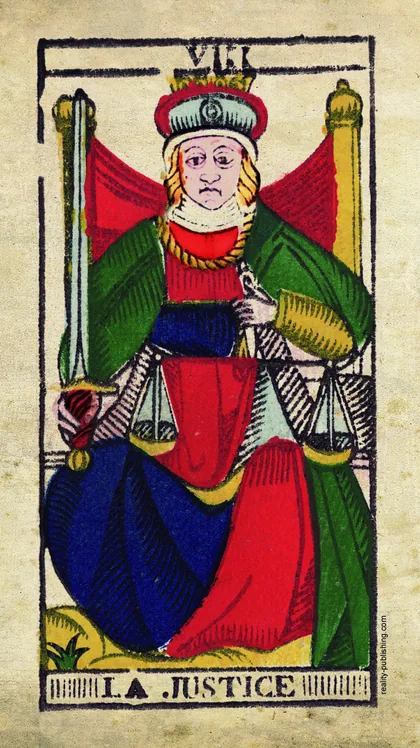
Arcana 8 in your personal brand at a glance
Your image gets its strength from the trust you inspire. A clear quote, a deadline met, an explanation without jargon: these details build a sturdier reputation than any campaign. People recommend you because they know what to expect from you, and that word of mouth remains the best showcase for this energy.
The pitfall is hiding behind rigor: flawless but cold presentations, texts so cautious that your voice disappears. Neutrality reassures, but it does not make people fond of you. Dare to take a stand on what seems right in your field; that is often what sets you apart from others.
- The card
- VIII · Justice
- The position
- Personal brand
By Thomas Guilhot · updated
The image you project
You give off a serious, upright image: that of a reliable, competent person who knows what they are talking about, meets deadlines, and gives a fair opinion even when it is unwelcome.
Colors and style
- Deep colors: burgundy, navy blue, charcoal gray, black
- A touch of gold or brass to signal high standards
- Classic suits with a clean cut
- Quality materials: cool wool, thick cotton, smooth leather
- Impeccable white shirts, structured collars
- A classic watch with a sober dial
- A well-made rigid bag or briefcase
- Polished shoes, simple lines, nothing loudly fanciful
- A tidy hairstyle that frees the face and the gaze
Positioning yourself
Rules, rights, and how to get them respected
Themes to carry
- Organization, method, and time management
- Professional ethics and transparency
- Understanding causes rather than enduring effects
- Balance between work life and personal life
Visual cues
- Colors: burgundy, midnight blue, charcoal gray, golden touches
- Materials: fine wool, leather, thick paper, brushed metal
- Style: classic and structured, straight lines, symmetry
- Symbols: scales, column, seal, quill
- Images: orderly offices, libraries, classical architecture
How people perceive you
Your audience sees you as a reliable source: someone who checks before publishing, explains the rules of the game, and promises only what they can keep.
Your authority is gentle but clear, and your audience expects from you a reasoned opinion rather than an emotion. This credibility is your main capital: it is built slowly and attracts a loyal and demanding audience. The downside is a distance that can seem cold, or a lecturing tone when you rule too quickly. Two questions to move forward: what injustice in your field do you really want to put right? And what would you show of your own mistakes to seem closer?
Your way of thinking
Your mind traces effects back to causes.
What helps it
Faced with a problem, you look for the hidden rule, the missing step, the decision that set everything off, then explain it in a logical order. You know how to compare options with clear criteria and weigh the consequences of each. Thanks to this rigor, a reader leaves your content with a course of action.
What hinders it
The block comes from a way of thinking that splits everything into two camps. You may reject an idea because it comes from a person you disapprove of, or look for fault rather than a solution. Perfectionism about accuracy also delays your posts. Admit that a nuanced, provisional opinion is better than perfect silence.
Your way of expressing yourself
To make yourself heard, bet on what clarifies: practical guides, explainer sheets, case analyses, reasoned comparisons, FAQs.
Videos where you break down a rule, a contract, or a decision showcase your clarity, and tables or diagrams make your demonstrations accessible. As for channels, a site with structured content, a regular newsletter, professional networks, and online talks or courses suit you better than pure entertainment platforms. Spontaneously, your voice sounds grave and methodical, almost solemn; soften it with examples drawn from everyday life, a few personal anecdotes, and a touch of humor. Publish on a fixed day: your consistency is part of the message, because it shows that you keep your commitments.
Ways to make a living from it
Plain-language explainers of labor law or family law
Niches
- Support with administrative and tax procedures
- Training in time management and organization
- Consulting for freelancers on choosing and managing their legal status
- Neighborhood, family, or business-partner mediation
- Audit and compliance for small businesses
- Preparation for civil service exams
- Workshops on ethics and decision-making in business
What blocks, what unblocks
The first obstacle to your reach is excessive caution.
You wait until you have checked everything, every source, every objection, before saying anything, and your competitors take the space in the meantime. The second obstacle is tone: words that judge, correct, or preach drive away part of the audience, even when they are right. Public quarrels with other creators, curt replies to comments, and settling scores do lasting harm to your credibility. Finally, promises not kept, a launch date pushed back, a series announced then abandoned, cost the 8 more than others, because the audience expects your word to be sure.
To unblock
- Announce a realistic publishing schedule and keep to it
- Publish a clear, provisional version rather than waiting for the perfect one
- Explain rather than judge: start from a concrete case, not a reproach
- Never answer an attack on the same day
- Share a mistake you made and what it taught you
- Feature client testimonials about your reliability
In everyday life
You are preparing a post to introduce your work.
The first draft reads like a brochure: services, rates, terms. Nothing false, nothing memorable. Rework it by telling a real case, made anonymous: the problem of the person who consulted you, the rule you refused to bend, the solution you found. End with what you stand for in your field. This story shows your sense of fairness better than a list of qualities.
A symbolic reading of the Destiny Matrix: food for thought about yourself, never a verdict or an established fact.
Go further
Justice
The card of energy 8Arcana 8 in the portrait
The same energy, in another position of the matrixPortrait 8 and its twelve talents
The same energy, in another position of the matrixArcana 8 in the couple matrix
The same energy, in another position of the matrixArcana 8 in a child’s matrix
The same energy, in another position of the matrix
How is it calculated?
Take March 14, 1987, a fictional date.
Perception is read in the portrait, a = 14, Temperance; the overall image in the center, e = 3. For thinking, a2 = 4 and b2 = 9; for expression, a1 = 17 and b1 = 6. Monetization is read at x2 = 11, a point on the money channel. Blocks come from the life lesson, d = 6, and from the reduced year, c = 7. Each section of the page points to the energy that occupies it.
Frequently asked questions: arcana 8 in your personal brand
Should you post your rates with this energy?
Often, yes. Justice benefits from transparency: posted prices, readable terms, a way of working that is explained. It filters out requests that do not suit you and reassures everyone else. If your work makes rates vary, give at least a range and the way you set it, with no detours or fine print.
How can a serious image become warmer?
Let what drives you show behind the rule: why fairness matters to you, the story that led you to this work. A photo of you at work, a thank-you posted publicly, a mistake acknowledged simply also humanize the whole. Rigor remains your foundation; warmth becomes your front door.
What if Justice is in my blocks?
Then it holds you back through excess scruple: fear of doing it wrong, a need for everything to be perfect before publishing, worry that someone will object to you promoting yourself. Set a publication date rather than a level of perfection. Showing your work is not unfair to anyone: it is useful information for those who are looking for it.
Personal brand: the 22 energies
Illustrations: Nicolas Conver’s Tarot de Marseille, dated 1760, restored by Tarot World Project, CC BY-SA 4.0 license, via Wikimedia Commons — images resized and compressed by Versana.