Arcana 5 in your personal brand
Explaining clearly is your signature: a kindly seriousness that makes people want to learn, especially when you dare to show yourself along the way.
- transmission
- teaching
- consistency
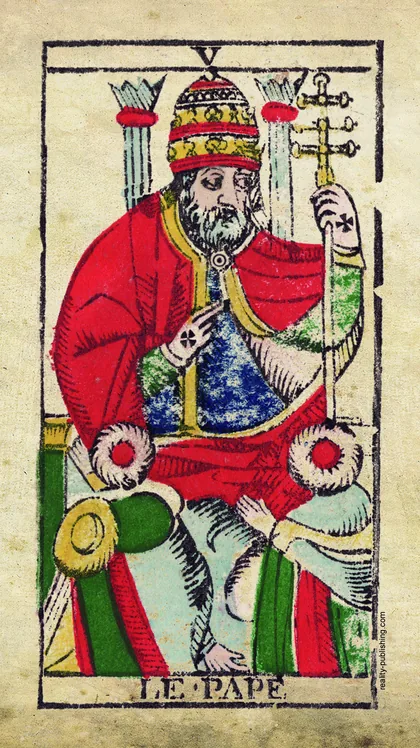
Arcana 5 in your personal brand at a glance
You know how to put a confusing subject back in order, give a landmark, explain without overwhelming. The public quickly grants you a serious trust, because your content comes back on a regular schedule and keeps its promises. This consistency turns passing readers into loyal regulars, who gladly recommend your resources.
Beware of the pulpit tone. By aiming for accuracy, you risk heavy content, corrections aimed at others, and knowledge offered from above. Doubts about your legitimacy also delay speaking up: one more diploma, one more rereading. Offer what you already master, and show that you keep learning.
- The card
- V · The Hierophant
- The position
- Personal brand
By Thomas Guilhot · updated
The image you project
You give off an impression of seriousness and goodwill: someone who knows what they are talking about, whose advice people follow, and to whom they would gladly entrust an important decision or the education of a child.
Colors and style
- Deep colors: midnight blue, burgundy, bottle green, charcoal gray
- A touch of gold reserved for great occasions
- Noble, durable materials: worsted wool, tweed, thick cotton, leather
- Classic, structured cuts, crisp shoulders, well-drawn collars
- Jackets, vests, or sport coats that give presence
- A quality watch, a sign of respect for time
- Glasses with an elegant frame, a notebook and a fine pen
- Discreet patterns: fine stripes, checks, herringbone
- A tidy, well-kept hairstyle, with no fashion statement
Positioning yourself
The transmission of knowledge and teaching
Themes to carry
- Values, ethics, and the meaning of life
- Family, roots, and genealogy
- Organization, method, and personal discipline
- Spirituality and the great wisdom traditions
Visual cues
- Colors: navy blue, burgundy, aged gold, off-white
- Materials: wool, tweed, thick paper, dark wood, patinated leather
- Style: classic and structured, straight lines, sober details
- Symbols: crossed keys, open book, column, candlestick
- Images: libraries, classrooms, cloisters, hands writing
How people perceive you
You are seen as a reliable source.
Your audience comes for a clear explanation, a method, a landmark in a confusing subject, and quickly grants you a form of authority. Your seriousness reassures, your consistency builds loyalty: those who follow you know they will learn something at every appointment. The downside is an image that is sometimes distant, a teacher’s tone that can intimidate or tire, and difficulty showing the person behind the expert. Two questions to reflect on: what deep conviction guides your work, and have you ever said it publicly? What past mistake could you tell about to show that you too learned by trial and error?
Your way of thinking
Your thinking is analytical and structuring.
What helps it
You know how to gather knowledge from different fields, sort it, and draw from it a three-part outline or a step-by-step method. Faced with a complex subject, you find the logical order of the presentation and the examples that make it understandable. This clarity gives your content lasting value: people keep it, share it, and come back to it.
What hinders it
What holds you back is a scholar’s standard. You feel you never know enough to publish, you accumulate training courses, and you dread making a mistake in front of a specialist. Your thinking can also freeze into a single system, to the point of rejecting new approaches in your field. Share what you already know, and each month read an author who contradicts you.
Your way of expressing yourself
Your expression finds its best place in formats that pass knowledge on.
Step-by-step tutorials, talks, online courses split into modules, practical sheets, in-depth articles, and books suit you. On-camera video works if you prepare a precise outline; live sessions with audience questions showcase your ability to answer accurately. As for channels, favor long-form content platforms, an educational newsletter, talks in schools, companies, or associations, and audio interview shows where you are questioned as a specialist. Your natural tone is calm, precise, and kind; keep it, slipping in memories from your own life and a touch of humor that brings people closer. Avoid jargon: the strength of the 5 is making simple what seems complicated, and your audience will follow you all the more if they feel able to apply what you teach.
Ways to make a living from it
Online courses and private lessons in your area of expertise
Niches
- Exam and competitive-test preparation
- Talks and corporate sessions on ethics or team leadership
- Writing practical guides, manuals, and method books
- Coaching in genealogy and family history
- Consulting on personal organization and paperwork filing
- Spiritual guidance, retreats, and reading circles for sacred texts
- Mentoring young professionals or future trainers
What blocks, what unblocks
Your visibility first runs into doubt about your legitimacy.
You wait for one more degree, for validation by peers, for flawless content before showing yourself, and time passes. Your tone can also work against you: a message that is too technical, posts that sound like a lecture, and corrections left in the comments of other creators. Some 5s refuse on principle the codes of social networks, which they find superficial, and deprive themselves of an audience that was only waiting to learn. Another obstacle: rebellion against platform rules, which leads to posting without regularity or strategy. Everything opens for the 5 when knowledge is offered with warmth and consistency, and the expert agrees to be seen learning too.
To unblock
- Publish what you already know without waiting for one more training course
- Translate each technical notion into an everyday example
- Keep a fixed weekly appointment with your audience
- Tell about a mistake or a personal lesson each month
- Invite other specialists, including those who think differently
- Learn a platform’s rules before judging them
In everyday life
You are preparing a short online course.
The outline is clear, each module precise, and yet the first feedback calls it dense. At the opening of each module, you add an anecdote: the mistake you made at the start, the question a participant once asked you. Participants relax, remember better, and dare to ask their own questions. The seriousness remains, but it now comes with a smile.
A symbolic reading of the Destiny Matrix: food for thought about yourself, never a verdict or an established fact.
Go further
The Hierophant
The card of energy 5Arcana 5 in the portrait
The same energy, in another position of the matrixPortrait 5 and its twelve talents
The same energy, in another position of the matrixArcana 5 in the couple matrix
The same energy, in another position of the matrixArcana 5 in a child’s matrix
The same energy, in another position of the matrix
How is it calculated?
Take March 14, 1987, a fictional date.
Perception is read in the portrait, a = 14, Temperance; the overall image in the center, e = 3. For thinking, a2 = 4 and b2 = 9; for expression, a1 = 17 and b1 = 6. Monetization is read at x2 = 11, a point on the money channel. Blocks come from the life lesson, d = 6, and from the reduced year, c = 7. Each section of the page points to the energy that occupies it.
Frequently asked questions: arcana 5 in your personal brand
Should I wait for a diploma to make myself known?
No. A title reassures, but the public first judges the clarity of what you offer. Say honestly where your knowledge comes from: training, experience, reading. Present yourself as someone who passes on what they have learned, not as an infallible authority. This sincerity often inspires more trust than a list of titles.
How can I avoid a professor’s tone?
Speak to one specific person rather than to a class. Tell a real situation before stating the rule, ask a question before giving the answer, and replace “you must” with “you can.” The substance stays rigorous; the form becomes a conversation, which makes your content much easier to follow.
Are social media conventions incompatible with my seriousness?
No. A short format is not hollow content: one well-chosen idea, well said in a minute, is sometimes worth a whole lesson. Adopt the conventions that serve your teaching and leave the others. You keep your values while reaching people who would never have come to you otherwise.
Personal brand: the 22 energies
Illustrations: Nicolas Conver’s Tarot de Marseille, dated 1760, restored by Tarot World Project, CC BY-SA 4.0 license, via Wikimedia Commons — images resized and compressed by Versana.