Arcana 5 in the couple matrix
A bond held by common values and rituals, which passes things on and reassures, and stays alive when the rules agree to be questioned.
- common values
- rituals
- passing on
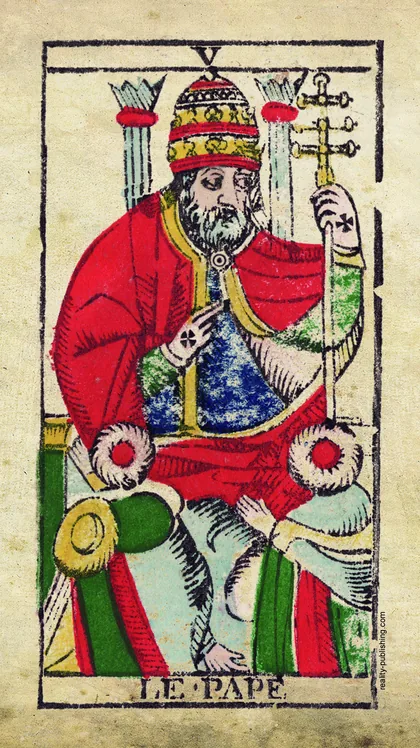
Arcana 5 in the couple matrix at a glance
This bond relies on shared landmarks. You know what matters: a given word, family, work well done. Rituals (Sunday meals, holidays, evening habits) give daily life flavor and continuity. Each learns from the other, and the couple becomes a place where the best of what each has received is handed on.
The danger is the rule that replaces the encounter. By repeating the model of one of the families, you stop asking what you really want. One partner may take on the role of the one who knows, the other the one who learns, and judgment sets in. Questioning a habit now and then lets the bond breathe.
- The card
- V · The Hierophant
- The position
- Couple matrix
By Thomas Guilhot · updated
The meeting
The 5 at the heart of a shared matrix signals a bond formed around common values.
The meeting often took place in a structured setting: studies, training, a place of worship, an association, an extended family circle, or through a respected relative. They recognized each other through a shared idea of family, of work well done, and of one’s word given. Their union is meant to build a solid home and to pass on, to children or to others, a body of knowledge and a way of living.
The couple’s resource
This couple draws its strength from its rituals and from what it learns together.
It is nourished by family meals, calendar holidays, visits to places steeped in history, books read and discussed as a pair, and courses taken together: a language, cooking, a spiritual practice. Trust rests on each person’s reliability: being there at the agreed time, keeping promises, protecting the other’s reputation. As long as the couple keeps a project of transmission, it moves through crises calmly.
The couple’s challenge
This couple has to learn flexibility.
It may freeze into rules that no longer make sense, repeat the pattern of one of the two families without questioning it, or let one of the two play the teacher to the other. Disagreements over raising children, religion, or sharing tasks quickly become matters of principle. A breakup can come from constant judgment, from in-laws interfering, or from the stifling of a partner who ends up looking elsewhere for a space of freedom.
The couple and money
This couple prospers when it bets on skill and the long term: a practice or school founded together, an inherited family business, a real estate portfolio built step by step, prudent investments.
The budget is often kept with rigor, which reassures but can turn into one person controlling the other’s spending. Setting written rules together, plus a share of free spending for each, preserves the peace.
A period together
Lived as a pair, a period 5 invites the couple, according to the method, to give itself a framework.
It may want to make the union official, to marry according to family traditions, to celebrate the arrival of a child, to sign a purchase deed, or to found a shared business. Questions of upbringing, values, and beliefs return to the center of conversations, and each discovers better where the other comes from. These years can also stiffen the relationship. One of the two sets themselves up as a lecturer, the rules of the house become a subject of dispute, an in-law family imposes its customs, and an administrative or legal file puts nerves to the test. Couples who know how to negotiate come out of it with fairer shared rules. Each has a role: listen before correcting, learn something together, and decide together what to keep from each family’s traditions and what to invent.
What can carry you
- A marriage, a blessing, or an official commitment
- A training course taken together that opens a shared project
- A real estate purchase or notarized deed well concluded
- A closer relationship with both families
What can be delicate
- A clash of principles over upbringing or religion
- In-laws too present in decisions
- Long administrative procedures that wear the couple out
Advice
- Write the house rules together and review them every year
- Create a tradition of the couple’s own, distinct from those of the families
- Replace the lecture with a question when a disagreement arises
In everyday life
On Sunday the family meal takes place as always, but one of you feels something ring hollow.
Instead of turning it into a reproach, keep the appointment and add a touch of your own: a new dish, a question asked at the table, a small ritual for two in the evening after the guests have left. The traditions remain, but now they carry your signature.
Possibilities, not a prediction: no period announces a certain event.
Go further
The Hierophant
The card of energy 5Arcana 5 in the portrait
The same energy, in another position of the matrixPortrait 5 and its twelve talents
The same energy, in another position of the matrixArcana 5 in your personal brand
The same energy, in another position of the matrixArcana 5 in a child’s matrix
The same energy, in another position of the matrix
How is it calculated?
Calculate the two matrices, then add their outer points two by two, reducing any total above 22 to the sum of its digits.
The inside is then recalculated from those sums. Fictional example: March 14, 1987 and May 8, 1990. Portraits 14 and 8 give 22; talents 3 and 5 give 8: the meeting reads as 22 and 8. The resource is 13, the shared lesson 11; money reads at x2 = 3 and c = 8.
Frequently asked questions: arcana 5 in the couple matrix
Do traditions necessarily matter in this couple?
They matter as landmarks, not as obligations. Some couples answer with religious festivals and rites, others with secular habits: a Friday game, a Sunday walk, a recipe passed down. What matters is that these gestures mean something to the two of you, and not only to one of the families.
What if our families do not get along?
First set a rule between the two of you: what each accepts or refuses as the presence of relatives. Speak with one voice, each with your own family, without relaying criticism. Then create neutral occasions, for example a meal in a third place. The couple then becomes the meeting point, not the battlefield.
Can a couple with no religion or family tradition recognize themselves in this?
Yes. The Hierophant speaks of passing things on and of values, which need not be religious at all. It might be involvement in a nonprofit, a work ethic, a way of raising children, or a love of reading. What defines this bond is choosing together what you want to hand on to others.
Couple matrix: the 22 energies
Illustrations: Nicolas Conver’s Tarot de Marseille, dated 1760, restored by Tarot World Project, CC BY-SA 4.0 license, via Wikimedia Commons — images resized and compressed by Versana.