Arcana 20 in the couple matrix
Two family histories brought together in a new home: a relationship that wakes up to what it inherited without repeating it.
- two lineages
- chosen home
- mended memory
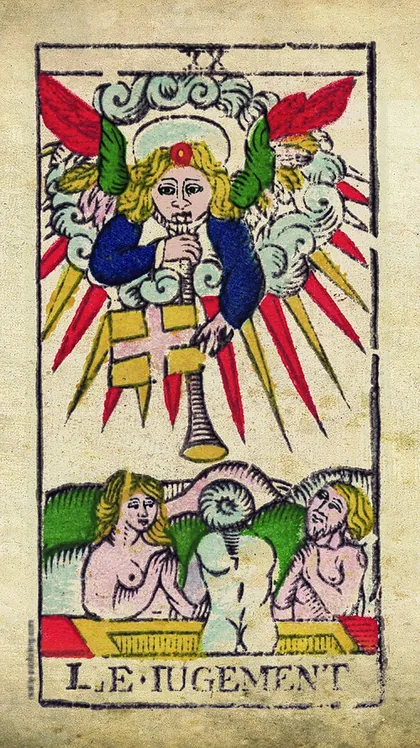
Arcana 20 in the couple matrix at a glance
Each brings their family, traditions, and values, and the couple makes them an alliance. It likes to invent rituals, host elders, pass on stories, and build for the long term (a house, a project, a legacy). This loyalty gives the bond a depth and stability that also reassure those around it.
The past pulls up a chair at the table. Without noticing, you replay your parents’ arguments, treat your lineage’s customs as the only norm, and judge those of the other. Loyalty to the elders can come before the couple. Asking yourselves, “Is this our rule, or our families’?” clarifies things quickly.
- The card
- XX · Judgement
- The position
- Couple matrix
By Thomas Guilhot · updated
The meeting
Placed in a couple’s matrix, the 20 turns the meeting into an appointment between two family histories.
Each recognized in the other similar values, an attachment to their roots, sometimes family trials that echo each other. The method reads in it a shared task: to repair together what their lineages had not managed to achieve, that is, a stable home, children raised with dialogue, an understanding between the two families.
The couple’s resource
Belonging fuels these two partners.
The couple recharges in family meals, in the traditions they invent, in photos filed in albums, in projects meant to last, like a house to pass on or a shared business. Telling each other about their childhoods, visiting each other’s places of origin, and hosting the elders sustains the bond. As long as each feels respected in their own history, the couple weathers storms with rare solidity.
The couple’s challenge
The shared lesson concerns the weight of the past.
The couple may replay their parents’ conflicts without seeing it, argue over an overly present mother-in-law, an inheritance, the choice of a first name or a place for a celebration. Another test is rigidity: each defends their family’s habits as the only valid ones. A breakup can come from a grudge nursed after an argument, or from a family loyalty that comes before the couple.
The couple and money
This couple earns well when it builds for the long term: a property, a family business, assets planned for the children.
The risk comes from inheritance issues, poorly framed loans between relatives, and neglected paperwork. A joint savings plan, written contracts with family, and careful filing of documents avoid many conflicts.
A period together
In the matrix tradition, a 20 period lived as a pair puts the families of origin at the center of the relationship.
The couple may be called on to look after an elderly parent, settle an estate, organize a big family event, or finally introduce the other to all their relatives. These moments bring them closer when each supports the other, and they show who can hold their ground in front of their own family. The period also invites a review: what the couple has built, what it repeats from earlier generations, what it wants to pass on. Fundamental decisions may ripen, such as settling near a family, taking over a family home, or starting a household. Old unresolved topics, how to split the holidays or how to raise the children, come back to the table. Each has a part to play: shielding the couple from outside pressure, stating their limits clearly to their own family, and choosing together which traditions to keep. Joint administrative procedures deserve special attention too.
What can carry you
- A family gathering where the two lineages meet
- A wedding, a birth, or a christening that brings people together
- Acquiring or taking over a family home
- A reconciliation with in-laws
What can be delicate
- A dispute over an estate or a gift
- In-laws who meddle in decisions
- Administrative procedures that drag on and irritate
Advice
- Agree together on how often to visit each family
- Put in writing any loan or gift between relatives
- Create a tradition of your own as a couple, independent of the families
In everyday life
A festive meal is approaching and the question comes up: whose place, with whom, which traditions?
Each defends their own with a fervor that surprises. Take a moment to tell, one after the other, what this meal meant in your childhood, without interrupting. Then invent a menu or a ritual that keeps a little of each family and adds a brand-new one, just for the two of you.
Possibilities, not a prediction: no period announces a certain event.
Go further
Judgement
The card of energy 20Arcana 20 in the portrait
The same energy, in another position of the matrixPortrait 20 and its twelve talents
The same energy, in another position of the matrixArcana 20 in your personal brand
The same energy, in another position of the matrixArcana 20 in a child’s matrix
The same energy, in another position of the matrix
How is it calculated?
Calculate the two matrices, then add their outer points two by two, reducing any total above 22 to the sum of its digits.
The inside is then recalculated from those sums. Fictional example: March 14, 1987 and May 8, 1990. Portraits 14 and 8 give 22; talents 3 and 5 give 8: the meeting reads as 22 and 8. The resource is 13, the shared lesson 11; money reads at x2 = 3 and c = 8.
Frequently asked questions: arcana 20 in the couple matrix
How do we protect the couple from the influence of families?
Decide between the two of you first, then announce together, with one voice, whatever concerns the couple. Respecting families does not mean obeying them. Set friendly limits: how often to visit, whether opinions are asked for or not. A solid bond readily welcomes loved ones, as long as it has been made clear who makes the decisions of shared life.
Do you need a united family to recognize yourself in this energy?
No. It can even describe a couple building what their family could not offer: a calm home, dialogue, recognition. Judgement evokes how you respond to an inheritance, whether joyful or difficult. Choosing what you keep and what you leave behind is already a way of writing your own lineage.
How do we pass things on without replaying our parents’ conflicts?
First spot the script: a sentence, an argument, a silence that resembles what you knew. Name it between you, with humor if possible, then choose a different response. Also tell the younger ones what went well. A family is passed down as much through repairs as through habits, and the couple can be its author.
Couple matrix: the 22 energies
Illustrations: Nicolas Conver’s Tarot de Marseille, dated 1760, restored by Tarot World Project, CC BY-SA 4.0 license, via Wikimedia Commons — images resized and compressed by Versana.