Portrait 20 and its twelve talents
Judgement ties every talent to a larger story, that of a family, an era, or a trade.
- handed-down gift
- talent of heritage
- long view
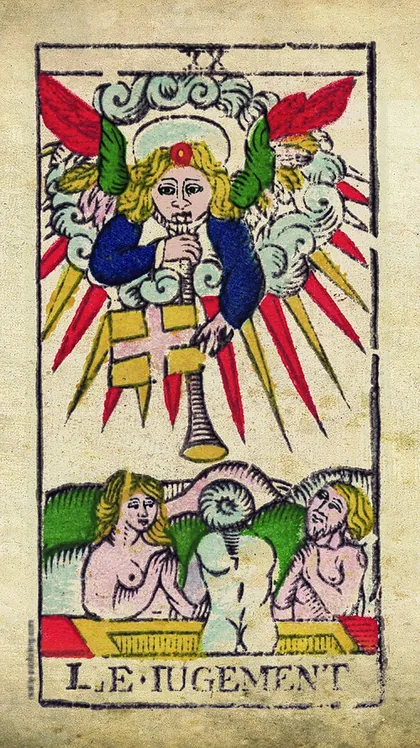
Portrait 20 and its twelve talents at a glance
In Judgement’s eyes, a talent never comes from nowhere: you look for its roots, anchor it in a lineage, and think about who will receive it next.
- The card
- XX · Judgement
- The position
- Portrait and talent pairings
By Thomas Guilhot · updated
The twelve talents of portrait 20
In Judgement’s eyes, a talent never comes from nowhere: you look for its roots, anchor it in a lineage, and think about who will receive it next.
This long view joins the Ferryman, which loves to pass things on, and the Framework, which builds to last. The friction comes from the Impulse, which wants to act before seeing everything, and from the Right Moment, which reminds you that opportunity cannot be planned. They teach this portrait to seize what passes without betraying its memory. Read each section looking for what your gift owes to those who came before, and what you want to add to it.
Judgement with The Magician (talent 1)
The 20 gives a broad vision, rooted in family and transmission; the 1 brings the talent for speech, initiative, and skill. Judgement supplies the foundation, the experience of generations, and a gaze that looks ahead; the Magician knows how to say it, sell it, and put it into practice by tomorrow. This pairing makes excellent speakers, trial lawyers, trainers, and founders of family businesses. Tension appears when the 1 grows impatient with the slowness of the 20: you want to act before weighing the consequences, then reproach yourself for the lack of perspective. The typical path begins with a career in communication, before an inheritance, a family story, or an advisory mission gives it direction. Success means joining quick speech with long reflection.
Strengths
- A voice that inspires trust through its clarity
- A talent for telling a family or collective story
- An ability to launch a project after planning its stages
- Ease in negotiating on behalf of a group
- A lively way of teaching a trade
- A tactical sense in important discussions
Weak points
- Hasty decisions regretted afterward
- Eloquence used to judge others
- Soft manipulation during family conflicts
- Projects launched to prove something to a parent
- Impatience with elders seen as too slow
- Paperwork neglected in favor of action
Judgement with The High Priestess (talent 2)
The 20 looks far across time, the 2 looks deep into things. This pairing joins two energies of knowledge: Judgement brings the memory of lineages and a sense of the system, the High Priestess brings intuition, silent study, and a taste for secrets. The result is a person who understands families, institutions, and the unspoken with rare acuity. Favorable fields are genealogy, archiving, family psychology, historical research, notary work, and mediation. The difficulty lies in the weight: carrying everyone’s secrets, dwelling on old stories, staying frozen in analysis. Life often begins with long years of study, sometimes a period of withdrawal after a family crisis, then recognition that comes late but stands firm. Success comes when accumulated knowledge serves to free people rather than to judge them.
Strengths
- A very fine intuition for family dynamics
- A precise memory for facts, dates, and connections
- Absolute discretion with confidences
- A taste for patient research in archives
- An ability to anticipate crises before they break out
- A calm that reassures in times of mourning
Weak points
- Family secrets carried alone for too long
- A tendency to dwell on past injustices
- Mistrust of newcomers to the circle
- Silence that turns into a mute reproach
- Analysis so thorough that it delays action
- A harsh judgment passed in secret on loved ones
Judgement with The Empress (talent 3)
The 3 brings a talent for creation, abundance, and beauty; the 20 places it within duration and transmission. Together they build a legacy: a restored family home, a business handed down to the children, a collection, a farm estate, a craft brand that crosses generations. The Empress gives Judgement warmth and fertility, while Judgement offers the Empress an overall vision and a sense of lineage. The tension comes from family expectations: creating what the family approves rather than what you desire, spending to keep up appearances. The typical path starts with a creative or commercial activity, then joins a family business or founds one. Success comes when the inheritance received is adapted freely, neither frozen in place nor disowned.
Strengths
- The talent of making an inherited asset grow
- A sure taste for the beautiful and the authentic
- The ability to gather the family around a project
- Prudent management of the family estate
- A sense of hospitality in an open house
- A creativity nourished by traditions
Weak points
- Spending to keep up appearances before the family
- Inheritance rivalries between siblings
- Creativity held back by parents’ watching eyes
- Possessiveness toward children and belongings
- A constant comparison with the success of ancestors
- Overindulgence at the table during family gatherings
Judgement with The Emperor (talent 4)
The 4 brings a talent for structure, command, and management; the 20 gives long-term vision and a sense of systems. The pairing makes builders of institutions: administrative directors, heads of family businesses, estate managers, civil service executives, farm managers. The Emperor gives Judgement the ability to decide, while Judgement gives the Emperor the wisdom to think of the next generation. The trap is rigidity: two energies of authority can produce a person who repeats the father’s model without questioning it, imposes their views, and tolerates challenge poorly. A career usually follows a methodical climb up the hierarchy, sometimes after a youthful revolt against the father. Success comes when authority becomes service and the rule adapts to people.
Strengths
- An ability to organize a structure to last for decades
- A sense of responsibility toward the extended family
- Exemplary financial and administrative foresight
- A calm authority that makes teams feel secure
- Respect for one’s word and for contracts
- A strategic vision grounded in experience
Weak points
- The reproduction of an authoritarian family model
- Difficulty accepting criticism from one’s children
- Open conflict with the state, the tax office, or a superior
- Rigidity toward new methods
- Evenings sacrificed to the office rather than the home
- Cold anger when the hierarchy is challenged
Judgement with The Hierophant (talent 5)
The 20 and the 5 resemble each other in their attachment to roots: one keeps the memory of lineages, the other passes on values, rites, and method. Their pairing produces memorable teachers, historians, religious or community leaders, family lawyers, and speakers on cultural heritage. The Hierophant offers Judgement a pedagogy, while Judgement gives the Hierophant a vision that reaches beyond a single generation. The tension arises from an excess of tradition: posing as guardian of the right way to live, judging the children’s choices, refusing change. The typical path often follows an elder or a mentor before asserting your own interpretation. Success comes when transmission leaves heirs the freedom to reinvent what they receive.
Strengths
- A rare talent for passing on history and values
- Loyalty to one’s teachers and students
- A moral authority recognized in the community
- A taste for rites that give meaning to life’s stages
- The patience to teach over the long term
- A solid sense of collective commitment
Weak points
- A conservatism that blocks the family’s evolution
- Moral lessons given without being asked
- Difficulty accepting choices that differ from one’s own
- A dependence on the judgment of a mentor or an institution
- The feeling of being the only guarantor of traditions
- Grudges against those who left the group
Judgement with The Lovers (talent 6)
The 6 brings the talent for loving, choosing, and creating harmony; the 20 places this talent within family history. This pairing plays out a great deal in couples and family: the choice of a spouse involves the lineage, and romantic relationships echo those of the parents. Lived well, it gives a person who builds strong bonds, reconciles estranged branches, and founds a warm, open home. Lived poorly, it repeats the romantic patterns of earlier generations or hesitates for a long time between personal desire and family expectation. Favorable fields are counseling for couples and families, wedding planning, family photography, and decorating old houses. Success comes from a free choice, made knowing your history without being ruled by it.
Strengths
- A talent for bringing estranged relatives back together
- A welcoming home for several generations
- Faithfulness in emotional commitments
- An aesthetic sense applied to the family heritage
- A sincere ear for other people’s love stories
- The ability to choose while knowing one’s roots
Weak points
- The repetition of the parents’ romantic patterns
- Hesitation between your own desire and the family’s opinion
- A comparison between the partner and a parent
- Jealousy toward the in-laws
- Choosing a partner to meet expectations
- Breakups experienced as a fault toward the lineage
Judgement with The Chariot (talent 7)
The 7 brings the talent for movement, conquest, and victory; the 20 gives the vision that directs this force. The Chariot without Judgement charges ahead, Judgement without the Chariot reflects without acting: together, they form strategists able to plan for the long term and then move into action with energy. They are found in project management, logistics, transportation, the military, local politics, and the growth of businesses across several regions. The tension comes from the family bond: leaving your people far behind or staying to carry them, leaving the framework or reforming it. The typical path includes a defining departure (studies, a transfer, living abroad), then a return to the roots with new experience. Success lies in a chosen movement, neither flight nor obedience.
Strengths
- An ability to plan, then execute quickly
- A strategic vision that anticipates obstacles
- The courage to leave in order to return stronger
- An aptitude for leading large-scale projects
- A taste for travel tied to history and origins
- Perseverance with slow administrations
Weak points
- Departures experienced as running away from the family
- Guilt toward the relatives left behind
- Impatience with institutions and regulations
- A stubborn competition with a brother or sister
- The need to prove one’s success to one’s parents
- A revolt against any imposed authority
Judgement with Justice (talent 8)
The 20 judges on the scale of generations, the 8 weighs actions with rigor and fairness: this pairing creates a very keen sense of justice, in the family as in society. It suits notaries, judges, inheritance lawyers, mediators, auditors, and compliance officers. Justice brings the rule and the measure, Judgement the understanding of deep causes and long time. The risk is severity: keeping everyone’s accounts, recalling old debts, judging a parent for distant faults. According to the method, this combination also invites repairing inherited imbalances. People readily begin with studies in law or administration and a career where they make rulings. Success comes when justice includes forgiveness and order serves the peace of families.
Strengths
- Great uprightness in settling estates
- Administrative and legal rigor
- An ability to arbitrate family conflicts
- An honesty that inspires the confidence of institutions
- A talent for putting old files back in order
- A vision of long-term consequences
Weak points
- Excessive severity toward other people’s faults
- Tenacious grudges tied to old injustices
- A need to settle the scores of the past
- Difficulty forgiving a parent
- A lack of flexibility when a case falls outside the rule
- Proceedings begun as a matter of principle
Judgement with The Hermit (talent 9)
The 9 brings the talent for solitary reflection and wisdom; the 20 widens it to collective memory and a vision of the future. This pairing gives thinkers, historians, philosophers, researchers in the humanities, and advisers consulted for their perspective. The Hermit offers Judgement the calm needed to understand, while Judgement gives the Hermit a reason to come out of retreat: to pass things on. The difficulty lies in isolation: withdrawing from the family out of weariness with conflict, judging the world from afar, brooding over old wounds. Life alternates phases of study or retreat with moments when you are called on as an adviser or witness. Succeeding means sharing your understanding gently, without shutting yourself into the position of the misunderstood sage.
Strengths
- A depth of reflection that sheds light on complex situations
- A precious perspective in family crises
- A broad historical and philosophical culture
- The wisdom to advise without imposing
- A leaning toward writing and long research
- Independence of mind in the face of group pressure
Weak points
- Isolation chosen out of weariness with conflict
- Brooding over family wounds
- Judgment passed on the world from afar
- Difficulty moving from reflection to action
- Mistrust of emotional impulses
- The bitter feeling of being misunderstood by one’s own
Judgement with Wheel of Fortune (talent 10)
The 10 brings the talent for following the flow, seizing opportunities, and bouncing back; the 20 gives the vision that links cycles together. Together they form people who understand trends before others do: investors, financial advisers, analysts, and entrepreneurs in tourism or period real estate. The Wheel makes Judgement more flexible, while Judgement gives the Wheel the depth and memory that prevent repeating mistakes. The downside is waiting: counting on an inheritance, a family stroke of luck, or a return of fortune instead of acting. According to the method, this combination invites breaking cycles that repeat in the family. The path includes several important turns. Success comes when each change is prepared and luck is joined to real work.
Strengths
- An intuition for economic and social trends
- A flexibility that lifts your head after a loss
- A sense of the right moment to sell, buy, or leave
- A well-maintained family and professional network
- Easy adaptation to changes in life
- The talent for breaking a cycle repeated in the family
Weak points
- Passive waiting for an inheritance or help
- Risky investments made on a hunch
- The repetition of the parents’ financial mistakes
- A tendency to blame fate
- Changing projects too often
- Neglect of administrative paperwork
Judgement with Strength (talent 11)
The 11 brings considerable strength, willpower, and physical endurance; the 20 gives it direction, vision, and a sense of lineage. This pairing forms people able to carry a family, a business, or an institution at arm’s length: farm managers, heads of small family companies, soldiers, firefighters, coaches, and leaders of heritage restoration sites. Strength gives Judgement the power to act, while Judgement teaches Strength to serve a cause greater than itself. The risk is hardness: wanting to impose your will on the whole family, wearing yourself out carrying others, reacting with anger. The typical path is demanding, with responsibilities taken on early. Success comes when this energy is measured out and rest becomes a decision.
Strengths
- An endurance that allows heavy responsibilities to be carried
- The will to protect the extended family
- Courage in crisis situations
- A remarkable capacity for physical work
- A sense of duty toward future generations
- Determination in the face of administrative obstacles
Weak points
- An overbearing authority within the family circle
- Exhaustion from too many responsibilities
- Outbursts of anger that leave a mark on loved ones
- Difficulty showing vulnerability
- Rigidity toward the choices of younger generations
- A refusal to accept outside help
Judgement with The Hanged Man (talent 12)
With the 12 come the art of seeing differently, a taste for service, and an aptitude for waiting; the 20 adds the vision and memory of the generations. This pairing invites you to see family history from a new angle: understanding a parent, letting go of a grudge, turning an inherited hardship into a work or a commitment. It is found among artists inspired by their roots, nurses and caregivers, end-of-life companions, volunteers, and transgenerational practitioners. The risk is sacrifice: devoting yourself to the family at the expense of your own life, carrying the burdens of ancestors, staying suspended between two choices. The path often includes a period of immobility followed by an awakening. Success comes when service is freely chosen and the fresh gaze opens a road for the whole lineage.
Strengths
- A fresh look at family history
- The gift of turning an old wound into a work
- Devotion to elderly or fragile people
- A deep patience in periods of waiting
- The talent for forgiving and easing tensions
- An artistic sensitivity nourished by roots
Weak points
- Sacrificing your own life for the family
- Inherited burdens carried without questioning them
- Prolonged indecision before major choices
- The feeling of being blocked by one’s history
- The role of victim of the ancestors, taken on without noticing
- Difficulty setting limits with loved ones
A symbolic reading of the Destiny Matrix: food for thought about yourself, never a verdict or an established fact.
Go further
Judgement
The card of energy 20Arcana 20 in the portrait
The same energy, in another position of the matrixArcana 20 in your personal brand
The same energy, in another position of the matrixArcana 20 in the couple matrix
The same energy, in another position of the matrixArcana 20 in a child’s matrix
The same energy, in another position of the matrix
How is it calculated?
The portrait comes from the day of birth, whose digits are added if it exceeds 22; the talent comes from the month, so always from 1 to 12.
That gives 22 portraits and 12 talents, or 264 pairings. For a fictional birth on March 14, 1987, the day gives a = 14, Temperance; the month gives b = 3, The Empress. The pairing is read on the page for portrait 14, in the section for talent 3: “Temperance with The Empress.”
Frequently asked questions: portrait 20 and its twelve talents
Does my talent come from my family?
It may recognize itself there: a seamstress grandmother, a handy uncle, a storytelling parent. This portrait helps you spot these echoes. Ask those close to you what they noticed in you as a child, and what earlier generations did. Heritage sheds light on your gift without locking it in: you keep the freedom to make something else of it, in your own way.
How do I avoid staying a prisoner of the past?
Tell apart what carries you from what holds you back. A tradition stays alive when you practice it in your own way, not when you repeat it out of duty. Choose one family habit to keep, another to let go, and talk it through with your loved ones. Your talent then becomes a thread that connects, rather than a debt to repay.
Portrait and talent pairings: the 22 energies
Illustrations: Nicolas Conver’s Tarot de Marseille, dated 1760, restored by Tarot World Project, CC BY-SA 4.0 license, via Wikimedia Commons — images resized and compressed by Versana.