Portrait 5 and its twelve talents
Here, a talent becomes knowledge to share rather than a personal advantage: the Hierophant explains it, ties it to principles, and passes it on.
- shared talent
- taught gift
- faithfulness to values
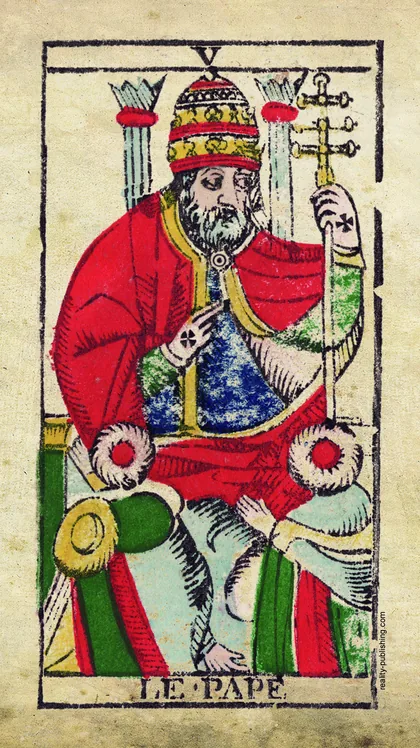
Portrait 5 and its twelve talents at a glance
When the Hierophant holds the facade, a talent seeks to be understood, explained, and passed on: you tie it to a tradition, a rule, students, or loved ones.
- The card
- V · The Hierophant
- The position
- Portrait and talent pairings
By Thomas Guilhot · updated
The twelve talents of portrait 5
When the Hierophant holds the facade, a talent seeks to be understood, explained, and passed on: you tie it to a tradition, a rule, students, or loved ones.
This calling easily joins the Scales, which share its taste for law, and Attunement, which offers it kindness. With the Ferryman, a doubled talent, passing on knowledge becomes the guiding thread of a life. The contrasts come from the Right Moment, which shakes certainties, and from the Impulse, which prefers to try before learning. They invite this portrait to leave a little room for doubt and play. Your knowledge grows on the day it accepts being contradicted.
The Hierophant with The Magician (talent 1)
The 5 establishes a reference-figure bearing, attached to rules and handed-down knowledge; the Magician adds a gift for starting ventures, lively speech, and manual dexterity. Together, they sketch a teacher who dares: someone who knows the tradition and can present it in a new way, who launches a training program, an educational channel, a private school, or a consulting firm. The friction comes from tempo: the Magician wants to start tomorrow, the Hierophant wants to verify everything first. The early years often alternate between projects launched too fast and degrees piled up for reassurance. The combination succeeds when the 1’s momentum serves a solid method, and the 5’s rigor stops holding back every first attempt.
Strengths
- Speech that brings a reputedly dry subject to life
- The boldness to create your own training structure
- A credibility that makes it easier to sell a new idea
- A taste for learning quickly and then teaching right away
- Practical skill in the service of demonstration
- The courage to speak in public early in life
Weak points
- Projects launched before the groundwork is laid
- Impatience with students who understand slowly
- The temptation to play the expert on a subject barely touched
- Conflicts with hierarchies judged too slow
- Brilliant talk that sometimes hides a lack of follow-through
The Hierophant with The High Priestess (talent 2)
Here, the 5’s official knowledge meets the 2’s inner knowledge. The portrait gives the stature of someone who teaches and guides; the talent adds fine listening, a feel for the unspoken, and an attraction to hidden knowledge. This double source makes sought-after advisors: spiritual guidance, psychology, teaching of traditions, documentation, research in the history of religions. The risk is swinging between two postures, the authority that asserts and the reserve that stays silent, to the point of never daring to say what you perceive. Often, it all begins with a classical education, usually a long one, followed by a more intimate opening to symbolism or caregiving. Balance arrives when intuition is owned and culture serves as its frame instead of muzzling it.
Strengths
- A way of listening that makes people want to confide
- The ability to explain a subtle notion clearly
- Absolute discretion about confidences received
- Broad knowledge, both bookish and intuitive
- A sense of the right moment to offer advice
- A reassuring presence in periods of doubt
Weak points
- Intuition silenced for fear of lacking proof
- Retreating into study at the expense of living bonds
- Playing the confidant so much that you forget yourself
- Distrust of anything outside recognized books
- Silences mistaken for coldness by those around you
The Hierophant with The Empress (talent 3)
The 5 brings tradition, rules, and a sense of family; the 3 offers a talent for fertility, abundance, and concrete creation. The pairing brings together the master and mistress of the house: you pass things on by nourishing, you teach by making things bear fruit. It finds happy expression in running a school or a nursery, publishing, regional gastronomy, a family business taken over and modernized. The tension lies in the relationship with money: the 5 is sometimes wary of comfort, the 3 plainly loves it, and you reproach yourself for your own wants. The typical path starts in a secure setting, then parenthood, an inheritance, or a place to bring to life triggers boldness. Success comes when you dare to earn generously from what you know how to pass on.
Strengths
- The talent for making a family home prosper
- A warm, close, and generous way of passing things on
- A sure taste for quality products and crafts
- The ability to manage a team like a household
- A grounding that reassures clients, students, and loved ones
- The gift of making old knowledge useful and profitable
Weak points
- A vague guilt whenever money comes in well
- The weight of family customs in every decision
- A generosity that sometimes becomes a form of control
- Creative projects postponed in the name of duty
- Difficulty letting children choose their own path
The Hierophant with The Emperor (talent 4)
Two energies of authority cross here. Portrait 5 embodies moral law and knowledge, talent 4 organization, protection, and concrete power. The pairing produces institution builders: school heads, magistrates, civil service executives, leaders of family businesses, heads of professional bodies. Structure is this duo’s great strength, and also its trap: the rule risks hardening into rigidity, authority into authoritarianism, especially at home. The typical path often follows a steady rise within a hierarchy, sometimes in the shadow of a demanding father, before you take the lead yourself. What makes it work: leading by explaining, accepting contradiction, and keeping some flexibility for situations the regulations did not foresee.
Strengths
- A natural authority founded on competence
- A sense of clear, respected procedures
- Total reliability in commitments made
- The ability to build a structure that lasts
- A taste for protecting those in your care
- A calm that holds in institutional crises
Weak points
- A rigidity that confuses firmness with harshness
- Difficulty admitting a mistake in front of a subordinate
- Tense relations with any competing authority
- A household run like an administrative office
- Refusing to delegate what you master
- A conception of respect that turns into obedience
The Hierophant with The Hierophant (talent 5)
When the 5 occupies both the portrait and the talent, the vocation of passing things on becomes the thread of life. The person inspires respect from the start, and the gift lies precisely in teaching, advising, and making knowledge accessible. This doubling gives memorable teachers, trainers, lawyers, chaplains, textbook authors, business mentors. It also exposes one to dogmatism: a single truth, a single method, debates closed with a quotation. The early years are often studious, sometimes marked by an admired master or a very present institution, and self-questioning comes late. The energy blossoms when you accept learning from those you teach, reading authors who disagree, and letting humor soften the lesson.
Strengths
- An obvious and lasting teaching vocation
- The clarity of exposition of a highly structured mind
- Unfailing loyalty to students and colleagues
- A vast culture, patiently accumulated
- A taste for guiding without expecting anything in return
Weak points
- A dogmatism that closes the door to dialogue
- Advice given without being asked
- Difficulty questioning yourself
- The temptation to judge those who live differently
- An excessive attachment to titles and degrees
- A circle limited to people who think alike
The Hierophant with The Lovers (talent 6)
The 5 gives the image of a guide attached to principles; the 6 offers a talent for connection, taste, and harmony between people. The duo is that of the kindly advisor: people come for an informed opinion and leave comforted. It shines in family mediation, human resources, marriage preparation, couples counseling, art teaching, and ceremony planning. The tension plays out between the rule and the heart: should you follow what is done or what you desire? Many hesitate for a long time between a reasonable choice approved by the family and a more personal attraction. The combination succeeds when the 5’s values help illuminate the choice instead of dictating it, and the 6’s gentleness softens the demands.
Strengths
- The talent for settling a conflict without hurting anyone
- Advice that is both fair and tactful
- An aesthetic sense put at the service of tradition
- Deep faithfulness in the relationships you choose
- The gift of gathering generations around a table
- A moral voice that stays warm
Weak points
- Long hesitations between duty and desire
- A love life subject to the family’s opinion
- A need for approval to feel legitimate
- Judgments about other people’s appearance or conduct
- A jealousy poorly admitted behind principles
The Hierophant with The Chariot (talent 7)
Portrait 5 brings the framework, knowledge, and respect for elders; talent 7 offers the movement, conquest, and endurance that carry a project to victory. The alliance makes leaders who advance with a doctrine: directors of traveling training programs, instructor officers, heads of humanitarian missions, pilgrimage guides, sports coaches. The contradiction is real: one wants to stay faithful to the path laid out, the other always wants to go further. You can spend years in a secure institution dreaming of action, then leave everything at once. Success comes when the 7’s mission is carried by clear values, and the 5’s knowledge agrees to travel, test itself against the field, and change course.
Strengths
- The ability to lead a team toward a precise goal
- Convictions that give meaning to action
- Teaching nourished by field experience
- A personal discipline that inspires others
- A taste for distant missions in the service of a cause
- A mentor’s energy that moves younger people forward
Weak points
- Abrupt breaks after long restraint
- A tendency to impose your direction on the group
- Overwork out of loyalty to a cause
- Intolerance of bureaucratic slowness
- Travel that takes you away from home and loved ones
The Hierophant with Justice (talent 8)
The 5 and the 8 both speak of law, each in its own way: the Hierophant passes on the moral rule, Justice weighs the facts and gives each person their due. Together, they form upright, rigorous, highly respected minds, at ease in law, the judiciary, auditing, inspection, medical ethics, and ethics committees. The downside lies in the demands: you judge yourself harshly, others even more, and family life sometimes resembles a courtroom. It generally begins with long studies, a career built on reputation, and often a case where you must choose between loyalty and truth. What makes it work: keeping mercy alongside rigor, and checking the facts before invoking principles.
Strengths
- An integrity recognized by all
- A sense of fairness in collective decisions
- A fine analysis of the causes of a problem
- Keeping your word, even when it costs
- The ability to defend the weaker against the stronger
- Solid expertise in questions of rules
Weak points
- An inner tribunal that spares neither you nor your loved ones
- Fear of error that delays decisions
- Presuming bad intent in those who deviate
- Difficulty forgiving an injustice suffered
- A need to be right to the end of a disagreement
The Hierophant with The Hermit (talent 9)
Portrait 5 teaches, talent 9 searches. This pairing marries transmission and the solitary quest: the person patiently accumulates knowledge, in books, archives, or meditation, then shares it with authority. It recognizes itself in university research, theology, philosophy, history, diagnostic medicine, essay writing. The difficulty lies in balancing withdrawal and presence: the 9 asks for silence, the 5 expects to be listened to, and you can cut yourself off from the world while blaming it for not understanding. The early years are slow and recognition comes mostly with age. Success is built by regularly stepping out of your study tower: publishing, giving lectures, accepting students who ask uncomfortable questions.
Strengths
- A rare depth of reflection
- The patience that long-term research requires
- Advice that is well considered, never given lightly
- A freedom of thought that resists fads
- A taste for passing on lived wisdom
- Intellectual friendships that stay faithful for decades
Weak points
- An isolation that sets in unnoticed
- Knowledge kept to yourself for lack of daring to publish it
- A cold distance toward loved ones’ emotions
- The conviction of being misunderstood by your era
- Distrust of any pleasure judged frivolous
The Hierophant with Wheel of Fortune (talent 10)
The 5 anchors the person in tradition, rules, and faithfulness; the Wheel of Fortune grants luck, a taste for change, and an intuition for cycles. This pair can seem contradictory, and that is precisely its richness: you know when to respect custom and when to seize the opportunity that passes. It finds good expression in teaching languages and travel, advising entrepreneurs, older real estate, organizing cultural or spiritual trips. The pitfall is turning down opportunities for fear of betraying your framework, then regretting it. The path often advances in cycles: a stable period, an unexpected encounter, a change of course. The combination succeeds when you trust chance while keeping your principles as a compass.
Strengths
- A sense of the right moment to propose an idea
- Happy encounters that open doors
- A wisdom able to accompany change
- The talent for making a tradition attractive to young people
- Quick adaptation without loss of values
Weak points
- Opportunities declined out of excess caution
- A superstitious reading of every coincidence
- The impression that luck has to be earned through effort
- Decisions put off while waiting for a sign
- An alternation of enthusiasm and withdrawal
- Resistance to changes imposed from outside
The Hierophant with Strength (talent 11)
The Hierophant brings measured speech and the authority of knowledge; Strength adds physical power and a will that does not let go. The duo produces imposing personalities, whom people listen to as much for their presence as for their arguments: coaches, martial arts masters, surgeons, site foremen who train apprentices, union representatives, school directors. The danger is convincing through pressure rather than explanation, and turning conviction into a fight. Many experience an early conflict with an authority figure, then become the authority in turn, with the same flaws. What makes it work: putting strength at the service of teaching, channeling energy into sports or a demanding trade, and leaving the other person room to answer.
Strengths
- A presence that commands respect effortlessly
- The tenacity to defend a cause for years
- The talent for training by example and by gesture
- Physical energy in the service of the group
- The courage to denounce an unjust rule
- Frank speech that does not back down
Weak points
- Anger when advice given is not followed
- The temptation to win a debate through intimidation
- Fatigue denied until exhaustion
- Repeated clashes with superiors
- Physical demands imposed on loved ones
The Hierophant with The Hanged Man (talent 12)
The 5 brings faith, rules, and a taste for teaching; the Hanged Man gives it devotion, compassion, and the art of looking at things upside down. The pairing makes guides who know how to come down to the other person’s level: hospital chaplains, special educators, teachers of struggling students, trainers in humanitarian work, those who support people at the end of their school or professional path. The tension comes from sacrifice: serving a cause or an institution can become a way of fading into the background, and the rule then serves as a pretext for never asking anything for yourself. The typical path goes through a period of intense devotion, sometimes a disillusionment, then a freer way of passing things on. Success comes when the gift is chosen, not endured out of duty.
Strengths
- A sincere compassion for the most vulnerable
- The ability to question a received idea
- Patient teaching, adapted to each person
- A sense of service without seeking glory
- A faith that sustains through difficult periods
- The gift of restoring hope to someone downcast
Weak points
- A devotion that turns into self-sacrifice
- Difficulty asking for fair pay
- A sense of injustice mulled over in silence
- Institutions served beyond what is reasonable
- The role of rule-bound martyr, played without noticing
A symbolic reading of the Destiny Matrix: food for thought about yourself, never a verdict or an established fact.
Go further
The Hierophant
The card of energy 5Arcana 5 in the portrait
The same energy, in another position of the matrixArcana 5 in your personal brand
The same energy, in another position of the matrixArcana 5 in the couple matrix
The same energy, in another position of the matrixArcana 5 in a child’s matrix
The same energy, in another position of the matrix
How is it calculated?
The portrait comes from the day of birth, whose digits are added if it exceeds 22; the talent comes from the month, so always from 1 to 12.
That gives 22 portraits and 12 talents, or 264 pairings. For a fictional birth on March 14, 1987, the day gives a = 14, Temperance; the month gives b = 3, The Empress. The pairing is read on the page for portrait 14, in the section for talent 3: “Temperance with The Empress.”
Frequently asked questions: portrait 5 and its twelve talents
Can a talent change with age?
It can be refined, shift, and sometimes reveal itself late. At twenty, people mostly live their facade; over time, the talent takes up more space, especially if the portrait is very structuring. Many people rediscover a gift they had set aside at forty or fifty. Rereading your section at regular intervals lets you notice what has moved.
Is passing on knowledge an obligation for this portrait?
No, it is a natural slope, not a duty. Passing on can take a thousand forms: explaining a recipe, keeping a notebook, showing a gesture to a child. If formal teaching does not appeal to you, look for the channel that suits you. What matters is that your knowledge circulates rather than staying locked away.
Portrait and talent pairings: the 22 energies
Illustrations: Nicolas Conver’s Tarot de Marseille, dated 1760, restored by Tarot World Project, CC BY-SA 4.0 license, via Wikimedia Commons — images resized and compressed by Versana.