Arcana 15 in a child’s matrix
A child with an iron will and disarming charm, who needs firm, fair limits kept with consistency.
- strong will
- charm
- clear limits
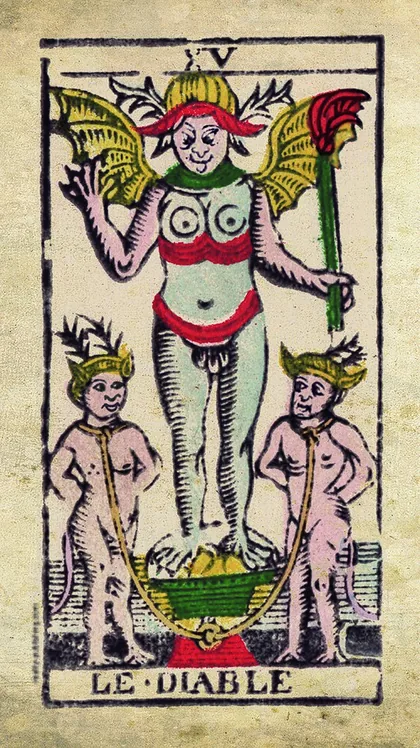
Arcana 15 in a child’s matrix at a glance
Your child knows what they want and says it plainly. This determination, well directed, lets them keep up an effort that others abandon. They have humor, magnetism, and a surprising endurance. When an adult stands firm calmly, they respect it, and their energy turns into real perseverance.
They test, they insist, they quickly spot your weak points: giving in one time out of three teaches them that stubbornness pays. Avoid public arguments, shame, and labels like “tyrant” or “mean.” What helps is the opposite: few rules, never negotiated in anger, and adults whose actions follow their words.
- The card
- XV · The Devil
- The position
- A child’s matrix
By Thomas Guilhot · updated
Their character
A child carrying the 15 overflows with energy and will.
They want everything, right now: the other child’s toy, the last slice of cake, the last word in the discussion. They test limits stubbornly and quickly figure out adults’ weak spots to get what they want. They can throw spectacular tantrums, but they also have a disarming charm, early humor, and great physical endurance. They like competitive games, stories of villains and monsters, pirate or witch costumes. What they need: firm but fair limits, adults whose words match their actions, and a daily physical outlet. What helps them thrive: burning off energy, winning honestly, and being accepted with their anger as well as their bursts of tenderness, without being called bad.
Advice for parents
- Sign them up for a combat or team sport to channel their strength
- Set few rules, but hold to them without exception
- Never shame them for their anger or make fun of it
- Talk about your own mistakes in front of them to show that they can be repaired
- Teach them to manage a small amount of pocket money
- Avoid smoking or drinking in front of them while preaching the opposite
- Go over an argument with them once things have cooled, looking for the lesson
- Let them win only when they have truly won
Girl or boy
In a girl, the 15 may be poorly accepted and quickly labeled a difficult personality: her strength should be valued instead. In a boy, the main thing is to keep domination from becoming his only way of existing in a group.
With others
At school, the 15 child quickly takes up space.
They often become a ringleader, organize games, set the rules, and negotiate trades of cards or snacks with a surprising business sense. Teachers describe them as sharp, charismatic, sometimes insolent, and in conflict with authority. They can be hard on the weaker kids or drag others into mischief. They respect adults who stand up to them calmly and scorn those who shout without acting. Help them put their anger into words, stand up for a classmate instead of dominating them, and admit their faults without losing face.
In everyday life
At the supermarket, your child demands the cereal on the top shelf, louder with each minute.
Eyes are on you, and the temptation to give in is strong. Breathe, recall the rule set before going in, then offer a real choice: one box from the list or nothing. If they shout, stay present without justifying yourself. In the car, talk about their outburst once things have cooled, without reproach: that is when they listen.
A symbolic reading to better understand a child: never a diagnosis or a label; a childhood professional remains the reference.
Go further
The Devil
The card of energy 15Arcana 15 in the portrait
The same energy, in another position of the matrixPortrait 15 and its twelve talents
The same energy, in another position of the matrixArcana 15 in your personal brand
The same energy, in another position of the matrixArcana 15 in the couple matrix
The same energy, in another position of the matrix
How is it calculated?
Nothing changes compared with an adult’s matrix.
Fictional example: a child born on March 14, 2018. The day gives a = 14; the month gives b = 3; the year gives 2 + 0 + 1 + 8 = 11, so c = 11. The lesson d = 14 + 3 + 11 = 28, reduced to 10. The center e = 14 + 3 + 11 + 10 = 38, reduced to 11. Character reads at 14 and 3, the relationship to others at 11.
Frequently asked questions: arcana 15 in a child’s matrix
Should I worry about such a strong will?
No: it is powerful, that is all. A force with a framework becomes endurance, courage, and an enterprising spirit. A force without limits looks for its borders through outbursts. Your role is to offer guideposts, a daily physical outlet, and a view that always separates the act from the person: the behavior is refused, the child stays welcome.
Should I let them win to avoid meltdowns?
Better to let them win when they truly win, and to lose without ceremony when they lose. Comment on the effort, not only the result. After a defeat, keep it simple: “Losing is disappointing, that’s normal.” They then learn that anger passes and that a next game exists, which is worth more than a handed-over victory.
How should I react when they defy me in front of others?
Keep your voice low and your tone neutral. Repeat the instruction just once, offer to talk again later together, then keep your word. Avoid lecturing them in front of the audience: humiliating them would push them to escalate. A challenge handled calmly shows them that your authority depends on neither volume nor an audience.
A child’s matrix: the 22 energies
Illustrations: Nicolas Conver’s Tarot de Marseille, dated 1760, restored by Tarot World Project, CC BY-SA 4.0 license, via Wikimedia Commons — images resized and compressed by Versana.