Arcana 19 in a child’s matrix
A sunny, engaging child, generous with their joy, who thrives when listened to, when their successes are celebrated, and when corrected without humiliation.
- contagious joy
- team spirit
- adults’ gaze
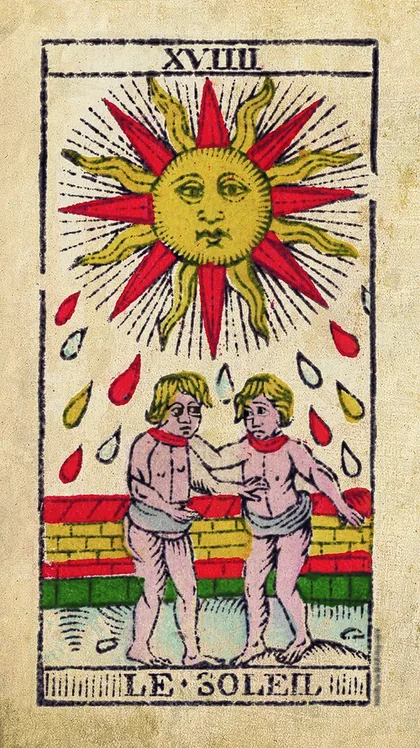
Arcana 19 in a child’s matrix at a glance
Your child brings light into the room when they walk in. They start games, gather cousins and friends, and thank with their whole heart. Their energy from morning to night can gladly serve a shared project. As soon as a specific task falls to them, they take it to heart and visibly grow.
Beneath the assurance, a reproach in public hurts them a great deal. Avoid correcting them in front of their friends or comparing them to another child. Avoid making them a confidant or referee of your adult tensions too: that place crushes them. If they start controlling everything, it is often because they feel poorly recognized.
- The card
- XIX · The Sun
- The position
- A child’s matrix
By Thomas Guilhot · updated
Their character
A child with the 19 is a little sun: cheerful, spontaneous, talkative, full of energy from morning to night.
They want to try everything, climb higher, run faster, organize the games at recess. They love parties, animals, the beach, team sports, and easily draw their brothers, sisters, and cousins into their adventures. Behind this confidence, they stay very sensitive to adults’ opinions, especially the father’s: a joke at their expense or a reproach in front of others hurts them deeply. When they feel controlled or humiliated, they may explode in anger, accuse, or, on the contrary, try to control everything around them. They need room to move, challenges that match their size, and adults who really listen. What helps them thrive: a home where you can laugh loudly, cry, and shout without being judged, and where their successes are celebrated.
Advice for parents
- Sign them up for a team sport or an activity where they can lead a group
- Welcome their anger by naming what they feel, then staying calm
- Tell them stories of people who succeeded after failures
- Let them give their opinion on outings and the week’s menus
- Avoid making them a confidant or a referee in adult quarrels
- Never correct them or compare them in front of their classmates
- Put them in charge of organizing a small family event
- Give them time outdoors, in the light, every day
Girl or boy
In a girl, the 19 often shows up in the role of a little boss or a protective older sister, which should not be held back. In a boy, it often takes the form of physical challenge and competition, with a strong need for the father’s approval.
With others
At school, the 19 child quickly takes a leader’s place.
They invent the games, hand out the roles, stand up for the little ones, and their classmates readily follow. Teachers find them lively, enthusiastic, helpful, sometimes overwhelming: they answer before being asked and have trouble waiting their turn. They work best when given a responsibility, handing out the notebooks, giving a presentation, welcoming a new student. Their difficulties appear when they want to impose their rules or another child overshadows them: they may sulk, get angry, or tease to regain the upper hand. Show them how to adopt a friend’s idea instead of their own, how to lose without drama, and how to congratulate a classmate who wins.
In everyday life
Saturday is the end-of-season party at the soccer club.
Your child hands out cups, laughs loudly, thanks the coach, then, seeing another child receive the trophy, withdraws. On the way home, skip “it’s only a game.” Name it: “You were happy for them, and a bit sad for yourself.” They feel seen, and the cheerfulness returns before dinner.
A symbolic reading to better understand a child: never a diagnosis or a label; a childhood professional remains the reference.
Go further
The Sun
The card of energy 19Arcana 19 in the portrait
The same energy, in another position of the matrixPortrait 19 and its twelve talents
The same energy, in another position of the matrixArcana 19 in your personal brand
The same energy, in another position of the matrixArcana 19 in the couple matrix
The same energy, in another position of the matrix
How is it calculated?
Nothing changes compared with an adult’s matrix.
Fictional example: a child born on March 14, 2018. The day gives a = 14; the month gives b = 3; the year gives 2 + 0 + 1 + 8 = 11, so c = 11. The lesson d = 14 + 3 + 11 = 28, reduced to 10. The center e = 14 + 3 + 11 + 10 = 38, reduced to 11. Character reads at 14 and 3, the relationship to others at 11.
Frequently asked questions: arcana 19 in a child’s matrix
Why do they find it so hard to wait their turn?
Their drive is quick and they want to take part right away. Train them with board games, an hourglass, a role as “timekeeper.” Value each time they wait, without irony. They learn that others’ attention is shared, and that their joy does not have to disappear to make room for someone else’s.
How should I react to their anger when they feel humiliated?
Wait for it to come down, in a quiet spot. Name the emotion without excusing the act: “You were angry because someone laughed at you.” Then look with them for a concrete way to make amends. They understand that one can be hurt without being mean, and you avoid adding shame to what they already carry. Calm returns faster when they feel understood.
Should I let them lead their brothers and sisters?
A little, if the rule is clear: they may organize a game, as long as everyone can refuse or suggest something. Alternate the leader role from one week to the next. They then learn to listen as much as to decide, and the younger ones feel neither crushed nor obliged to follow. Your individual attention to each child remains the key.
A child’s matrix: the 22 energies
Illustrations: Nicolas Conver’s Tarot de Marseille, dated 1760, restored by Tarot World Project, CC BY-SA 4.0 license, via Wikimedia Commons — images resized and compressed by Versana.