Arcana 17 in a child’s matrix
Creative and bright, this child dares to show what they imagine to a kind audience, and so learns to carry their ideas through.
- imagination
- sense of beauty
- kind audience
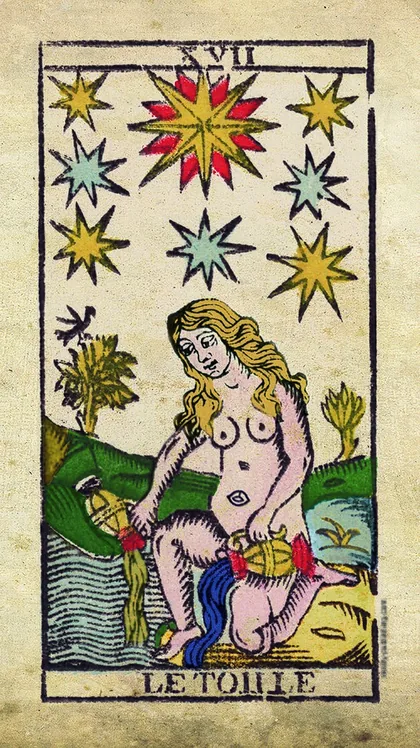
Arcana 17 in a child’s matrix at a glance
Your child sees beauty where others pass by: an insect, a sky, an old rag turned into a costume. They stage shows, sing, draw, and their joy is contagious. They also sense the mood of a room finely. Once recognized, they dare, and their enthusiasm lifts the whole family.
The risk is turning them into a showcase: exhibiting them too early, expecting performances, dreaming their success for them. A compliment that comes every single time ends up weighing on them. Avoid mockery too, even tender, of their creations or their looks. A child watched only for what they show may stop creating.
- The card
- XVII · The Star
- The position
- A child’s matrix
By Thomas Guilhot · updated
Their character
A child carrying the 17 is imaginative, expressive, and very sensitive to beauty.
They invent stories, sing in front of the mirror, dress up, put on shows for the family, and ask to be watched. They love nature, animals, the stars, and can spend a long time watching a sunset or an insect. They sense adults’ moods finely and guess at a tension before it is named. They need caring attention, sincere compliments, and an audience for their creations; ignored or mocked, they may either demand attention through noise and tantrums, or stop creating and get bored. What helps them thrive: varied artistic activities, outings in the open air, and adults who believe in their potential and help them carry their ideas through to the end.
Advice for parents
- Attend their home shows and truly applaud
- Enroll them in acting, singing, dance, or art classes
- Display their drawings and creations around the house
- Take them to watch the stars, the sea, the forest
- Help them finish a project before starting another
- Never laugh at their dreams, even the most fanciful
- Teach them to let other children speak
- Photograph and film them so they get comfortable with their image
Girl or boy
A 17 girl may worry about her appearance very early: help her see her worth in what she creates. A 17 boy sometimes hides his artistic sensitivity for fear of mockery: encourage him to show it.
With others
At school, the 17 child easily draws attention.
They suggest the games, readily speak up in class, volunteer for the June show, and bring classmates along with their ideas. Teachers describe them as creative, full of imagination, sometimes dreamy or a little too much into performing. They learn better through images, stories, and projects than through repetition. Their fragile points appear when they feel invisible: a classmate who gets noticed more, a hurtful remark about a drawing or an outfit can push them to clown around or withdraw. Teach them to listen as much as they talk, to be glad about others’ success, and to keep faith in themselves even when nobody applauds.
In everyday life
Friday evening, your child has put on a show with their stuffed animals and demands that everyone come to the living room.
You had planned something else. Put the phone down, sit, and applaud for real. Then ask a precise question: “What did you like inventing most?” This attention is worth a thousand “well done.” The next day, suggest writing the story in a notebook: the idea becomes a project.
A symbolic reading to better understand a child: never a diagnosis or a label; a childhood professional remains the reference.
Go further
The Star
The card of energy 17Arcana 17 in the portrait
The same energy, in another position of the matrixPortrait 17 and its twelve talents
The same energy, in another position of the matrixArcana 17 in your personal brand
The same energy, in another position of the matrixArcana 17 in the couple matrix
The same energy, in another position of the matrix
How is it calculated?
Nothing changes compared with an adult’s matrix.
Fictional example: a child born on March 14, 2018. The day gives a = 14; the month gives b = 3; the year gives 2 + 0 + 1 + 8 = 11, so c = 11. The lesson d = 14 + 3 + 11 = 28, reduced to 10. The center e = 14 + 3 + 11 + 10 = 38, reduced to 11. Character reads at 14 and 3, the relationship to others at 11.
Frequently asked questions: arcana 17 in a child’s matrix
Should I sign them up for an art class right now?
If the wish is there, try a discovery workshop rather than a yearlong enrollment. See whether they find their joy there or feel constrained. The taste for creating is also fed at home, with paper, fabric, and time. What matters is that they keep the pleasure, not that they acquire technique early.
How can I help them take a comment about what they create?
Always start with what you truly like, with precision, then offer a single idea, phrased as a question: “What if the dragon had bigger wings?” Leave them free to turn it down. Show them that artists constantly rework their pieces. They learn that a comment serves the work and takes nothing away from the person who imagined it.
What if they cannot stand another child shining more?
This is a delicate moment for a child who likes to be seen. Acknowledge what they feel without dramatizing: “You wish it had been you.” Remind them that several talents can coexist. Encourage them to congratulate the other child: the esteem received in return is worth more than attention grabbed through noise, and it lasts longer.
A child’s matrix: the 22 energies
Illustrations: Nicolas Conver’s Tarot de Marseille, dated 1760, restored by Tarot World Project, CC BY-SA 4.0 license, via Wikimedia Commons — images resized and compressed by Versana.