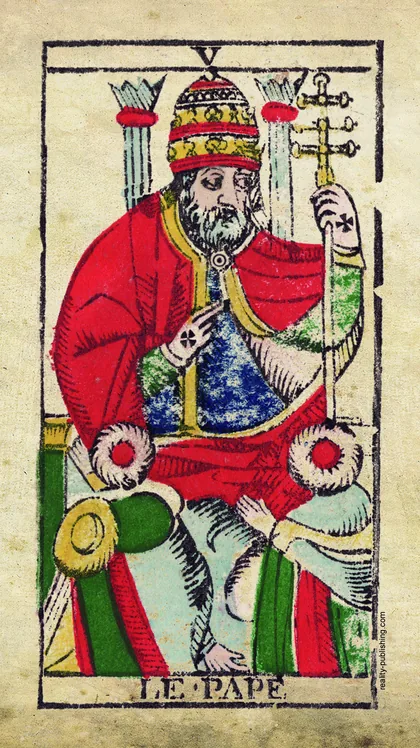
The Hierophant highlights what your family holds important: values, traditions, and landmarks that people choose to pass on.
passed-on values
family traditions
shared landmarks
The essentials
Arcana 5 between parents and children at a glance
A strength
You give meaning to what the family lives. A ritual, a celebration, a habit of reading or conversation: you know how to turn these moments into landmarks the younger ones will remember. Your taste for passing things on links the generations to one another and gives them the feeling of belonging to a shared story.
Something to watch
Holding on to a tradition can become a way of defending it against any change. The younger ones, like their elders, sometimes need to adapt customs to their time. Asking everyone what really matters to them in the ritual keeps the transmission alive rather than obligatory.
The 5 placed here points to a childhood lived under a regime of rules: homework checked every evening, grades commented on, outings subject to conditions, principles repeated at the table.
With your parents
The 5 placed here points to a childhood lived under a regime of rules: homework checked every evening, grades commented on, outings subject to conditions, principles repeated at the table. Resentment dissolves when you measure what this framework gave: a sense of effort, a culture, a word kept. Choosing your own adult rules while keeping regard for your father and mother lets you turn the page.
With your children
With the 5, you pass on landmarks: bedtime, a love of reading, family celebrations, a clear morality. The right stance is to explain rather than impose: say why a rule exists, share the book the child has chosen and talk about it with them, accept that they push back. The danger would be to play the boss who decides everything, comments on every mistake, and demands a respect that you do not grant them. The more ground you give on small things, the more your authority on essentials is heard, and the warmer the relationship becomes in adolescence.
Here, from one generation to the next, the Hierophant speaks of what a family considers right, good, and worth keeping. In your parents’ home, strong rules, beliefs, or habits gave direction. This can remain as a precious foundation, or as a set of norms you had to question in adulthood.
With the younger ones, you are a go-between. Bedtime, the celebrations observed, the evening readings form a fabric that reassures. But what they retain most is how you embody these values yourself, far more than what you say about them.
Finally, the line invites you to sort things out with kindness. Keeping what nourishes, rephrasing what no longer fits, inventing new rites: the Hierophant is not the enemy of change when it stays faithful to the spirit of what you want to pass on. Each generation can thus write its part of the shared story.
The Hierophant in your life
In everyday life
The day before a family celebration, you take out the old recipe notebook your parents used.
A child is amazed by the slanted handwriting, a cousin offers to add her own dishes. You gladly agree, and the notebook becomes a place where several generations meet. The next day, you keep the big gathering around the table and the opening toast, but you let the younger ones choose the music and the decorations. No one feels obliged, and everyone seems glad to have a say.
What helps
What helps
Ask each generation what matters to them in a ritual
Tell the origin of a family habit before suggesting it
Invent a new rite with the younger ones
The Hierophant, parents and children: nuances
Where it sits in the matrix
These points: portrait, parents and children, parents and children (inner).
Portrait
The way people perceive you at first sight, your calling card. Active from birth.
Parents and children
What you received from your parents, and what flows from one generation to the next.
Parents and children (inner)
What you pass on to your children, or to the younger people you guide.
A symbolic reading of the Destiny Matrix: food for thought about yourself, never a verdict or an established fact.
The portrait is the starting point, then the center is added to it.
Fictional example, March 14, 1987: the portrait is 14 and the center 3. The transmission point adds the two, 17, the Star. The received inheritance point adds the portrait and this transmission: 14 and 17 make 31, then 3 and 1 make 4, the Emperor. The full line therefore reads 14, 4, 17, from the portrait toward the center.
Frequently asked questions: arcana 5 between parents and children
What does the Hierophant mean in the parent-child line?
He points to the values, traditions, and landmarks that pass from one generation to the next. He can suggest a family with firm principles, or the wish to pass some on. This line invites you to identify what you want to keep, in your own way and at your own pace, without outside pressure or comparison with others.
How do you pass on your values without imposing them with the Hierophant?
By living them rather than stating them. The younger ones watch your choices far more than they listen to your speeches. Explaining the reason for a habit, accepting questions, and leaving room for a variation keep the transmission alive, and so easier to adopt freely when the time comes, without being forced.
How do you move away from a family tradition with the Hierophant?
By saying so respectfully and offering another form. It is rarely a matter of rejecting everything: you can keep the spirit of a ritual while changing its form. Explaining what weighed on you and what you want to keep helps loved ones understand without feeling rejected or judged.
Illustrations: Nicolas Conver’s Tarot de Marseille, dated 1760, restored by Tarot World Project, CC BY-SA 4.0 license, via Wikimedia Commons — images resized and compressed by Versana.