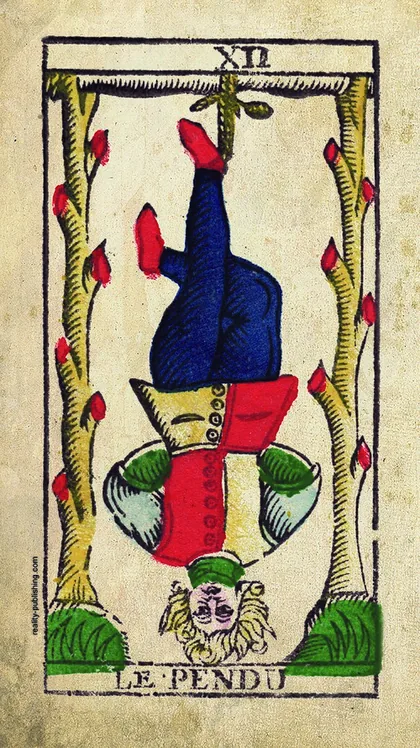
The Hanged Man changes the way you look at your family: by letting go of what weighs on you, you pass on a way of helping without sacrificing yourself.
reversed view
help without sacrifice
family letting go
The essentials
Arcana 12 between parents and children at a glance
A strength
You know how to step back when a conflict drags on between two generations. Instead of defending a position, you change angle and look for what each person is really trying to say. This flexibility calms discussions and shows younger people that a stuck situation can be seen differently, without losing face.
Something to watch
Stepping aside for others can become a habit. By carrying the family’s expectations, you forget your own wishes and wait for someone to notice. Saying clearly what suits you, and accepting that some relatives can manage on their own, makes the help you give lighter and fairer.
The 12 placed here points to a childhood spent carrying worries that were not yours: a sick, exhausted, or unhappy parent who had to be spared, an atmosphere where complaint stood in for conversation, sometimes an affection that came through guilt.
With your parents
The 12 placed here points to a childhood spent carrying worries that were not yours: a sick, exhausted, or unhappy parent who had to be spared, an atmosphere where complaint stood in for conversation, sometimes an affection that came through guilt. It eases when you hand your parents back their own difficulties, recognizing that they did what they could within their limits, and when you make an important decision without waiting for their agreement.
With your children
The 12 makes you pass on compassion and a taste for helping: your children learn at your side to visit an isolated neighbor, to give away toys, to listen to the other’s version during an argument. The right attitude is to teach them also to say no, to defend their opinion, to look for an unexpected solution when they are stuck. Take part together in a collection drive or a volunteer action. The trap would be to overprotect them by doubting their strength, or to get their obedience by playing on guilt and on your fatigue.
On the line of the generations, the Hanged Man speaks from an upside-down point of view. On the parents’ side, it evokes a history in which everyone had a supporting role: the one who smooths things over, the one who fades into the background, the one who repairs misunderstandings. This sharing of invisible tasks shaped the way you are useful, sometimes without anyone asking your opinion.
On the children’s side, the reading concerns what you show. A person who knows how to wait, listen, and give up being right offers younger people a quiet lesson: you can matter to your own people without forgetting yourself. Your children, or the young people you look after, remember how you get through pauses and disagreements far more than your explanations.
This line invites you to sort through inherited duties. Some commitments to the family nourish; others come from an old loyalty that no one has ever questioned. Looking at them from a little distance lets you keep what resembles you and set down the rest, without denying any of the attachment.
The Hanged Man in your life
In everyday life
At a holiday meal, two family members trade an old remark back and forth.
Rather than settle it, you suggest starting the story over, each telling their version. The children listen, surprised to see the adults change tone. The next day, you politely decline to take charge of organizing the next lunch, suggesting taking turns. This small step shows that help can be shared and that saying no is compatible with affection. Everyone leaves feeling heard.
What helps
What helps
Restate in your own words what the other person said, then respond
Share family tasks on a rotating basis
State one personal need out loud each week
The Hanged Man, parents and children: nuances
Where it sits in the matrix
These points: portrait, parents and children, parents and children (inner).
Portrait
The way people perceive you at first sight, your calling card. Active from birth.
Parents and children
What you received from your parents, and what flows from one generation to the next.
Parents and children (inner)
What you pass on to your children, or to the younger people you guide.
A symbolic reading of the Destiny Matrix: food for thought about yourself, never a verdict or an established fact.
The portrait is the starting point, then the center is added to it.
Fictional example, March 14, 1987: the portrait is 14 and the center 3. The transmission point adds the two, 17, the Star. The received inheritance point adds the portrait and this transmission: 14 and 17 make 31, then 3 and 1 make 4, the Emperor. The full line therefore reads 14, 4, 17, from the portrait toward the center.
Frequently asked questions: arcana 12 between parents and children
What does the Hanged Man mean between parents and children?
It evokes the place of service and stepping back in the family line: who set themselves aside, who carried the others, who learned to look differently. This line does not say the family lacked something. It invites you to spot the role you received and to choose what you want to carry forward.
How do you help relatives without forgetting yourself, with the Hanged Man?
By saying from the start how far your availability goes. Help offered with its limits stays pleasant for everyone, and spares you the feeling that you must always show up. Remembering to ask for help in return, even for a small thing, rebalances the exchanges and shows younger people that giving and receiving go together in a family.
Does the Hanged Man mean accepting everything in the family?
No. Letting go does not mean keeping quiet or putting up with things. This energy suggests loosening what is secondary so as to keep the strength to set limits where it really matters. A disagreement expressed calmly, with a fresh look at the situation, protects the relationship better than forced acceptance or an endured silence.
Illustrations: Nicolas Conver’s Tarot de Marseille, dated 1760, restored by Tarot World Project, CC BY-SA 4.0 license, via Wikimedia Commons — images resized and compressed by Versana.