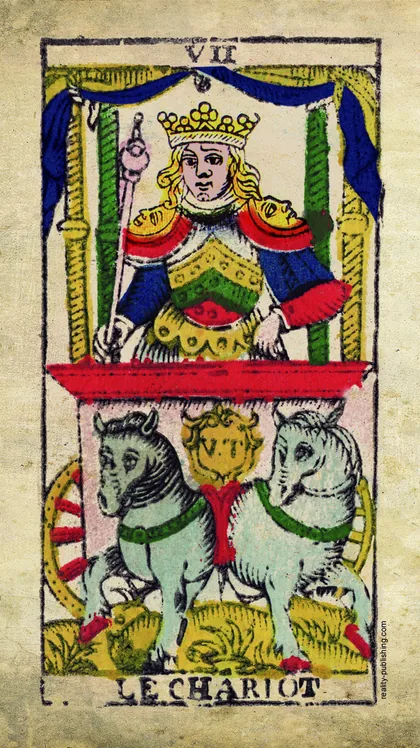
The Chariot sets the family in motion: each person learns to take the reins of their own course, carried by the momentum of their people.
family momentum
personal direction
passed-on independence
The essentials
Arcana 7 between parents and children at a glance
A strength
You give others a taste for moving forward. Outings, trips, projects carried through to the end: you draw the family into a dynamic that helps everyone grow. The younger ones discover at your side that effort leads somewhere and that a heading, even a modest one, brings joy when you hold to it.
Something to watch
Charting other people’s route for them risks provoking resistance. A project designed for a child or a parent may not match their deeper wishes. Asking about their own direction, then supporting them in it, is more fruitful than moving forward for them.
Placed here, the 7 often signals a childhood grievance toward parents who wanted to decide your trajectory: an imposed school track, hobbies chosen without consulting you, parental ambitions to fulfill.
With your parents
Placed here, the 7 often signals a childhood grievance toward parents who wanted to decide your trajectory: an imposed school track, hobbies chosen without consulting you, parental ambitions to fulfill. The resentment dissolves when you measure what their demands or their absence also taught: autonomy, tenacity, a taste for leaving. Telling them about a project that succeeded is sometimes enough to reconnect.
With your children
With the 7, you leave your children a love of effort and movement: bike rides, family trips, the habit of finishing what you start. The right reflex: push the child toward their own goals, not yours. Let them choose their sport, instrument, or track, and let them lose a match without a sermon. Show them how to set a goal, then let them advance at their own pace. The trap would be to turn their schedule into a training program and to measure your affection by their results.
Here, the Chariot speaks of how each person steers their life within the family. In your parents’ time, choices of direction were sometimes made without you, or else you were encouraged to go far away. What often remains is a keen sensitivity to the question of freedom, and to what you decide for yourself.
For the younger ones, what counts is movement. You give them the wish to train and explore: sports, trips, challenges taken on. They remember your advice less than the way you get back up after a failure and set off toward a new goal.
The Chariot also invites you to respect the independence of each generation. Letting a parent run their life as they see fit, letting a child choose their path: that is its finest victory. Closeness is then lived as support along the road rather than guidance, and everyone moves at their own pace without losing contact with the others.
The Chariot in your life
In everyday life
One Saturday, you organize a family hike.
A teenager lags behind, a grandparent would rather stay at the café. Rather than rushing them, you suggest two routes: one demanding, the other relaxed, with a shared meeting point for lunch. At the finish, everyone tells their journey with pride. You realize the day was a success precisely because each person could choose their own pace. On the way home, you think of everything you gained: laughter, crossed stories, and the shared pride of having each moved forward at their own step.
What helps
What helps
Ask each person what heading they want before suggesting yours
Celebrate efforts, not only victories
Plan a pace suited to each generation in shared projects
The Chariot, parents and children: nuances
Where it sits in the matrix
These points: portrait, parents and children, parents and children (inner).
Portrait
The way people perceive you at first sight, your calling card. Active from birth.
Parents and children
What you received from your parents, and what flows from one generation to the next.
Parents and children (inner)
What you pass on to your children, or to the younger people you guide.
A symbolic reading of the Destiny Matrix: food for thought about yourself, never a verdict or an established fact.
The portrait is the starting point, then the center is added to it.
Fictional example, March 14, 1987: the portrait is 14 and the center 3. The transmission point adds the two, 17, the Star. The received inheritance point adds the portrait and this transmission: 14 and 17 make 31, then 3 and 1 make 4, the Emperor. The full line therefore reads 14, 4, 17, from the portrait toward the center.
Frequently asked questions: arcana 7 between parents and children
What does the Chariot mean in the parent-child line?
It points to momentum and independence in the family: who decides, who moves forward, who accompanies. It can suggest a childhood that was strongly directed or strongly encouraged to leave. This line invites you to find the balance between support and freedom for the generations around you, without imposing anything on anyone.
How do you support a child’s autonomy with the Chariot?
By letting them steer their own projects, even modest ones, and staying available to help them adjust. Asking questions rather than giving solutions leads them to find their own heading. Celebrating their efforts and attempts, whatever the result, strengthens their wish to move forward on their own and their confidence in their own abilities.
How do you get past a disagreement about direction with a parent with the Chariot?
By recognizing that everyone has a right to their own road. Explain what motivates your choice, listen to the worries hiding behind the advice you receive, and look for what you share, such as the wish to do things well. A decision made calmly is often better understood than you first imagine.
Illustrations: Nicolas Conver’s Tarot de Marseille, dated 1760, restored by Tarot World Project, CC BY-SA 4.0 license, via Wikimedia Commons — images resized and compressed by Versana.