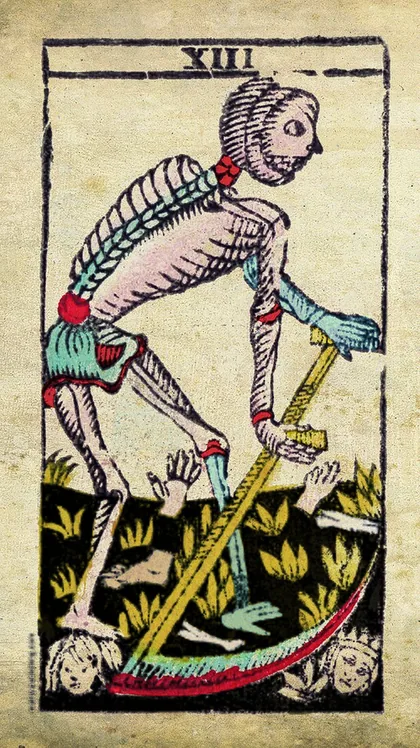
Your ease, with the nameless arcana, lies in setting back in motion what has bogged down: sorting, cutting, then rebuilding on cleared ground.
art of sorting
restart
courage to renew
The essentials
Arcana 13 in the talent at a glance
A strength
You instinctively see what is over. A poorly arranged room, an overloaded schedule, a project that leads nowhere anymore: your eye isolates what must go so the rest can breathe. This talent is useful wherever a situation has to change state, and it grows stronger with every transformation carried through to the end.
Something to watch
The talent for sorting can be applied too quickly. Cutting before understanding, proposing to redo everything when a touch-up would do, rushing people who do not share your taste for change: the gift turns harsh. Giving each person the time to make the passage keeps your help valued rather than dreaded.
Your talent is shedding your skin and helping others do the same.
It shows when you relaunch a business that is losing steam, when you support a loved one after a separation, when you turn a rundown apartment into a bright place. It is put to use in emergency and rescue work, business turnarounds, renovation, career-change coaching, psychotherapy, and end-of-life and grief support. To cultivate it, learn to conclude: celebrate the end of a project, put away the archives of a period, write down what it taught you. Also train in first aid and stress management.
This gift often shows up after a first crossing: leaving the family home, a path given up, a first job left behind. You notice that a closed chapter gives you more momentum than it takes away, and that you can help other people cross the same threshold.
Its form varies with the point. At the top of the diamond, the nameless arcana looks like a calling for passages: accompanying, transforming, setting things upright again. Expressed day to day, it becomes a practical art of sorting and putting things back in order. Deeper down, it is lived as a quiet trust in cycles: what ends prepares something else. Coming from the paternal ancestral line, this talent evokes forebears who had to start over entirely, after an exile, a war, or a reversal of fortune; coming from the maternal line, figures who kept the household standing through upheavals. The talent then consists in turning this memory of rupture into know-how, without keeping the fear.
This gift is refined by patience. The better you can accompany each ending, name it, prepare it, and celebrate it, the more lasting your transformations become, for you as much as for those you help.
Death in your life
In everyday life
An acquaintance has been hesitating for two years about leaving an apartment that is too dark.
In one evening, you help them list what is truly holding them back, and the decision almost makes itself. At the office, you are handed the closing of projects nobody wants to finish: archiving, taking stock, leaving the room clean for the next team. At home, a room changes function every two or three years, and each rearrangement gives you fresh energy for the rest of your life.
What helps
What helps
Finish one transformation before starting a new one
Train in change management or project management
Mark each closed stage with a concrete gesture: a meal, a tidy-up, a letter
Death, talent: nuances
Where it sits in the matrix
These points: received talent, expressed talent, inner talent, paternal ancestral line (spirit), father’s talent (inner), father’s talent, maternal ancestral line (spirit), mother’s talent (inner), mother’s talent.
Received talent
What comes easily to you, your link with what is greater than you. Takes its place around age 20.
Expressed talent
The form your talent takes in everyday life.
Inner talent
The source of your talent, the most inward one.
Paternal ancestral line (spirit)
What the father’s side passes on in talents and values. Around age 10.
Father’s talent (inner)
The talent of the paternal line, closest to you.
Father’s talent
The talent of the paternal line as it is passed on.
Maternal ancestral line (spirit)
What the mother’s side passes on in talents and values. Around age 30.
Mother’s talent (inner)
The talent of the maternal line, closest to you.
Mother’s talent
The talent of the maternal line as it is passed on.
A symbolic reading of the Destiny Matrix: food for thought about yourself, never a verdict or an established fact.
The received talent is simply the number of the month in the year, with no reduction at all.
For an imaginary birth on March 14, 1987, March gives 3, the Empress. The expressed talent adds the center, here 3, making 6; the inner talent adds that 6 to the month, making 9. On the father’s side, the corner is the portrait plus the talent, 14 and 3, making 17; add the ancestral power, 6, to get 23, reduced to 5, then 17 and 5 make 22. On the mother’s side, the corner is the talent plus the material point, making 10; then 10 and 6 give 16, and 10 and 16 give 26, reduced to 8.
Frequently asked questions: arcana 13 in the talent
Is the nameless arcana a hard talent to carry?
It takes courage, because it touches what many people dread: the end of things. In an environment that values stability, it can seem unsettling at first. Once recognized, it becomes a rare resource, sought after in moments of crisis, reorganization, or renovation, where few people dare to step in.
How do you recognize the nameless arcana among your talents?
Look at what you do better than others in moments of rupture. If a crisis makes you clearer instead of paralyzing you, if people call on you to clear out, reorganize, or restart, if you love seeing a place or a project reborn, this talent is probably active in your life.
What does the nameless arcana pass down through the ancestral lines?
A memory of fresh starts. The reading links this energy to families who went through ruptures: migrations, changes of circumstance, trades abandoned for others. It gives you the capacity to bounce back, and sometimes an apprehension about change inherited from elders. The work consists in keeping the first and setting down the second.
Illustrations: Nicolas Conver’s Tarot de Marseille, dated 1760, restored by Tarot World Project, CC BY-SA 4.0 license, via Wikimedia Commons — images resized and compressed by Versana.