21:12 and 12:21: two twin hours
The same digits the other way around: the two halves swap places, and the total stays 6.
- 21:122 + 1 + 1 + 2 = 6you are here
- 12:211 + 2 + 2 + 1 = 6Read 12:21 →
21:12 is the hour of harmony at home: bringing your private choices in line with those of the people close to you, gently.
This is the moment to listen to your feelings without getting lost in them, and to keep time for yourself.
A gentleness toward yourself and toward your own people.
Merging into shared life to the point of disappearing.
By Thomas Guilhot · updated
For tradition, two 1s in the center, between two 2s, evoke a will surrounded by listening: the idea of deciding while keeping others close.
21:12 takes the digits of 12:21 and turns them around. This time, the 2s occupy the ends and the 1s sit in the center, side by side. The image changes: it is no longer the individual who holds the relationship, it is the bond, the home, the group that surrounds two personal drives. The 2 speaks of listening and sensitivity; the 1, of autonomy and decision. Within a shared frame, two wills touch.
The total does not move: 2 + 1 + 1 + 2 = 6. Neither do the halves, 21 and 12 each being worth 3. What differs is the order, and therefore the emphasis. The 6 of 21:12 speaks less of what you give than of how you live together under one roof: sharing space, respecting each person’s rhythm, leaving room for the two 1s in the center.
The time of day reinforces this reading. At 21:12, most people are home. Dinner is over or nearly so, the dishes are waiting, the children are dragging their feet before bed, someone is choosing a movie and someone else would rather read. Living together is negotiated in the details, through small arrangements.
Where 12:21 looks outward, toward the colleagues and relatives you meet at noon, 21:12 turns toward the inside of the home. The two hours complement each other: one asks what you offer, the other what you preserve.
At 21:12, the dishes are waiting and two wishes cross in the living room: one of you would like to go out for a walk, the other to finish a book.
The two 1s pressed together in the center of the hour describe this scene well, two wills within the same frame. The 6 seeks harmony and sometimes mistakes it for doing everything together. Ask yourself: when was the last evening you each spent on your own, without having to justify it?
Living without a partner often means having arranged your evenings your own way: a dinner ritual, friends on Thursdays, a couch to yourself.
The 6 of 21:12 likes the idea of a shared home, and the 1s in the center hold on to that rhythm. Before any encounter, list your typical evenings: which could you share, and which do you insist on keeping? Choosing someone whose rhythm lets yours breathe matters as much as attraction does.
At 21:12, the workday should be over.
If this hour finds you in front of work emails, the 6 asks a direct question: who are you helping by working right now? A sense of responsibility, a real quality, easily slides into permanent availability. The two 1s in the center remind you that your personal time deserves the same protection as a client’s deadlines. In a team, this hour can also shed light on your role: do you systematically inherit the chores nobody wants? The 3 of the halves suggests raising it at the next team meeting, calmly, with examples.
For money, 21:12 turns the gaze toward the household budget: rent, groceries, shared expenses, and the portion each person keeps for themselves.
The two 1s in the center defend a personal margin, while the 6 holds to the common pot. A useful question tonight: was the split in your home chosen together, or did it settle in over time?
21:12 comes up often in the writings of the twin flame currents.
They read two souls in a mirror: the 1s in the center, pressed against each other inside the 2s, would picture an extraordinary bond, whose stages some authors describe. This reading is reported here as it stands, without affirming or contesting it; it sets neither a date nor an outcome. What the number adds: the 6 describes a bond lived day to day, under one roof, and the two 1s remind you that each person remains whole in it. A strong bond, whatever its name, leaves room for the two people who form it.
The twin flame: where the idea comes from, what can be observed
The same digits the other way around: the two halves swap places, and the total stays 6.
The angel Mehiel, tarot card 21, and the message as tradition reads it.
Mehiel
The Kabbalistic tradition gives each of its 72 angels twenty minutes of the day: 21:12 falls within those of Mehiel, the 64th.
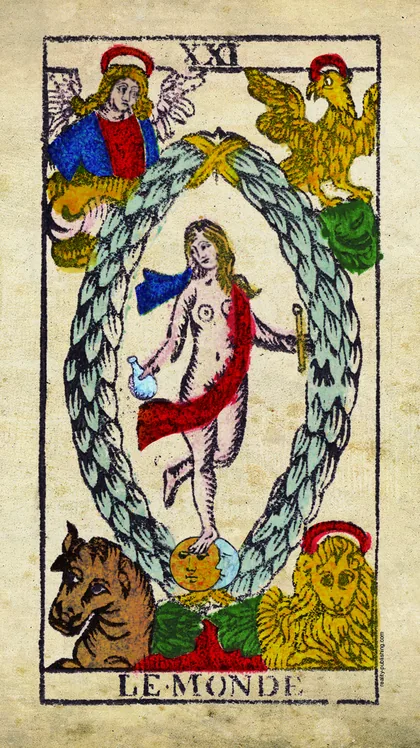
The World
The reading of hours links 21:12 to the card that bears the hour’s number, 21.
The meaning you find in it is up to you. Read the profile of Mehiel, or see the 72 guardian angels.
Two readings can coexist: the symbolic reading and the attention reading.
A meaningful coincidence, Jung would say; a message, say the angelic traditions. Either way, 21:12 speaks to you about yourself more than about chance.
Of the 1,440 minutes in a day, 21:12 takes up only one, yet it catches the eye: a doubled time sticks in the mind, and once you have noticed it, you watch for it. Both readings can coexist.
Set a time after which you no longer answer work messages, and keep it for seven evenings in a row.
If 21:12 often shows up on your screen, make it that marker.
The mirror hours and angel numbers made of the same digits, and the number they repeat.
2112 means balance in relationships: bring what you want for yourself in line with what you live as a pair.
21:12 · reversed hour
21:12 is the hour of harmony at home: bringing your private choices in line with those of the people close to you, gently.
2 + 1 + 1 + 2 = 6 · How to read a mirror hour
A time is read through its digits, its two halves, and its total: add the four digits, then reduce to a single one (11, 22, and 33 stay whole).
Each digit adds its own shade before the total.
21 and 12 both reduce to 3: the same number, with the digits in another order.
This number gives the time its main reading.
2 + 1 + 1 + 2 = 6
The calculation is identical: both hours give 6, with two halves equal to 3. Only the order of the digits changes. In 12:21, the 1 frames the 2: the individual carries the relationship, and the reading leans toward what you give. In 21:12, the 2 frames the 1: the shared frame surrounds two wills, and the question becomes that of personal space within shared life.
21:12 speaks of life as a couple at its most everyday: the evening, the home, the shared time. Its 6 likes harmony at home; its two 1s in the center remind you that each person needs moments of their own. It invites you to ask whether your relationship leaves enough space for each of you, without prejudging what comes next.
Not in the strict sense. In a mirror hour, the minutes reproduce the hour exactly: 21:21 is one. 21:12 is a reversed hour: its minutes take the hour read backward. In everyday language, the two families are often grouped under the same name, which is why the site presents them together, each with its own definition.
The two 1s in the center of 21:12 speak of independence, the 2s at the edges of meeting, the 6 of commitment. Without a partner, the question is about the place you would make for someone: your schedule, your evening habits, your friends. The 6 likes to plan a home; the 1 holds to its rhythm. Picturing a shared week in concrete terms helps you see what you would agree to change.
For part of the tradition, an hour that answers itself like this would translate a shared thought at a distance. It is a belief you can welcome without being able to confirm it for a given person. What 21:12 proposes, as evening comes: when calm returns, absent people take up space, and the 6 speaks of those you feel responsible for. If one of them comes to mind, do you feel like checking in on them?
The total does not set these two hours apart: 2 + 1 + 1 + 2 and 2 + 1 + 2 + 1 both give 6, with halves worth 3. 21:21 is a mirror hour, where the minutes copy the hour; 21:12 is reversed, its minutes reading the hour from right to left. The first sets the same pattern down twice, like an evening habit that comes back; the second encloses the two 1s between the 2s, the image of two wills at the heart of a home.
2112 takes the four digits of the hour without separating them: you come across it on an invoice, a postal code, a page number. The method stays that of all hours, digit by digit, and you find 6 again, which keeps its meaning: shared life and care for those close to you. Read this way, 2112 loses only the evening setting that colors 21:12; the symmetry remains.
Tap a time to read its meaning.