10:01 and 01:10: two twin hours
The same digits the other way around: the two halves swap places, and the total stays 2.
- 10:011 + 0 + 0 + 1 = 2you are here
- 01:100 + 1 + 1 + 0 = 2Read 01:10 →
10:01 is the hour of the first step: crossing a distance and reconnecting with someone left on the other shore.
You are invited to reach out to the other person without waiting for them to make the first move.
A quiet courage for reconnecting.
Letting silence settle in out of habit.
By Thomas Guilhot · updated
Tradition sees in the two 1s at the ends an intention framing the void: two impulses facing each other, and the idea of bringing your thoughts in line with your actions.
At 10:01, the two 1s stand at the two ends of the display, and two zeros fill the middle. The same sequence reads in both directions, like an arch of which you would see only the two pillars. The hour, 10, reduces to 1; the minutes, 01, are worth 1 as well. Adding the four digits gives 1 + 0 + 0 + 1 = 2.
The total, 2, concerns the bond between two people: agreement, attention, nuance. But here the two units do not touch. Between them lies a gap to cross. The 10 of the hour adds a precision: it is the 1 accompanied by a zero, a beginning that already has a little space around it. Where two people could pass each other without seeing one another, the 2 asks who will take the first step toward the other.
Ten oh one is the heart of the morning. Messages arrive, appointments begin, and you wait for the reply to an email sent the day before. The moment faces outward, toward the day’s exchanges.
Its twin, 01:10, brings the two 1s together in the center, in the middle of the night. 10:01 pulls them apart, in broad daylight. One speaks of a closeness to be settled, the other of a distance to be bridged. If 10:01 catches your eye, ask yourself which relationship deserves a sign from you: a call put off, an invitation never returned, a disagreement left hanging.
As a couple, the two zeros that separate the 1s of 10:01 look like those weeks when you only cross paths at breakfast and at bedtime.
The bond holds, but it lives on hints. The 2 invites you to make the gap visible rather than endure it: a message at noon that is not about groceries, a question about the meeting the other person was dreading. Ask yourself who in your relationship bridges the distance most often, and whether that role weighs on you or suits you.
Without a partner, 10:01 draws attention to the space you leave between yourself and others.
Two 1s at the ends: each on their own side, friendly, available in theory. The 2 asks who will cross over. You can notice someone at the book club for months without ever suggesting you continue the conversation. That is not a flaw, more a distance that has become habitual. Choosing begins here with a modest step: a personal question, a simple invitation, made in the morning light.
10:01 suggests cooperation at a distance: a team spread over several sites, a client you never meet, a colleague in the next department with whom everything goes through writing.
Two competent people can each move ahead on their own there without ever coordinating. The 2 draws attention to what connects: a regular progress check, a question asked rather than an assumption made, a report sent to the right person. Look at your exchanges this week: which would have been better handled in a live conversation rather than a three-line message?
On the subject of money, 10:01 and its two 1s separated by two zeros suggest accounts kept separately: parallel budgets, a loan between friends never mentioned again, a shared bill whose balance nobody tracks.
The 2 suggests a clear, calm review. With whom does an account remain open, and could you settle it with a simple conversation?
The same digits the other way around: the two halves swap places, and the total stays 2.
The angel Lecabel, tarot card 10, and the message as tradition reads it.
Lecabel
The Kabbalistic tradition gives each of its 72 angels twenty minutes of the day: 10:01 falls within those of Lecabel, the 31st.
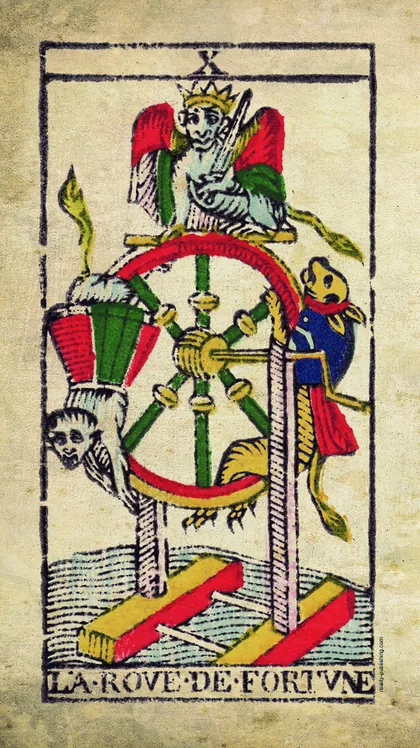
Wheel of Fortune
The reading of hours links 10:01 to the card that bears the hour’s number, 10.
The meaning you find in it is up to you. Read the profile of Lecabel, or see the 72 guardian angels.
Two readings can coexist: the symbolic reading and the attention reading.
For many people, seeing 10:01 again is a synchronicity in Jung’s sense: a meaningful coincidence, which tradition reads as a message.
Of the 1,440 minutes in a day, 10:01 takes up only one, two on a 12-hour display: a doubled time sticks in the mind, and once you have noticed it, you watch for it. It is up to you to see which one speaks to you, or both.
When 10:01 appears, send a short message to someone you have drifted apart from.
No long explanation: a piece of news, a question, or a shared memory is enough to narrow the gap.
The mirror hours and angel numbers made of the same digits, and the number they repeat.
1001 means harmony: bring your actions in line with your thoughts, and rely on your own decisions.
10:01 · reversed hour
10:01 is the hour of the first step: crossing a distance and reconnecting with someone left on the other shore.
1 + 0 + 0 + 1 = 2 · How to read a mirror hour
A time is read through its digits, its two halves, and its total: add the four digits, then reduce to a single one (11, 22, and 33 stay whole).
The same digit 2 times: the reading dwells on it.
10 and 01 both reduce to 1: the same number, with the digits in another order.
This number gives the time its main reading.
1 + 0 + 0 + 1 = 2
10:01 tells you nothing about how a story will continue. It offers a theme: the distance between two people and how to cross it. Its total, 2, speaks of listening and agreement; its two distant 1s remind you that each person keeps their own ground. The useful question is simple: who in your relationship makes the first move, and does that role sometimes change hands?
Not in the strict sense: it is a reversed hour. A mirror hour repeats the same pair, like 10:10, whereas here the minutes flip the hour: 10 becomes 01. 10:10 also gives 2, by the way, but through another shape: two identical 10s rather than a reversal. 10:01, for its part, reads the same way from left to right and from right to left.
In mid-morning, 10:01 puts initiative first: the 1 opens the hour, and the 2 of the total closes it. Without a relationship, the question is about the first move: are you waiting for someone to come to you, or do you dare to suggest a drink, a walk, a visit? As a couple, the final 1 reminds you that each person keeps their voice: the agreement of the 2 does not require one to be silent so the other can decide.
For some readers of mirror hours, 10:01 would be the reflection of a thought reaching you; it is impossible, however, to attribute it with certainty to a given person. The 2 of the hour speaks precisely of reciprocity. If it makes you hope for a sign, look at the balance of your exchanges with that person: who follows up, who answers? The two zeros in the center stand for an empty space; a message fills it better than waiting.
The calculation does not tell them apart: 2 in both cases, with two halves that are worth 1. What changes is the pattern and the time of day. 10:01 opens and closes on a 1, like two people keeping a polite distance, in the middle of morning activity. 01:10 sticks the two 1s together in the middle of the night. The first speaks of a contact to resume, the second of an agreement to find up close.
Read as a number, 1001 recalls the Thousand and One Nights, and readings of angel numbers readily make it an encouragement to start something with someone. The calculation remains that of the hour: 1 + 0 + 0 + 1 = 2. Two beginnings frame an emptiness; numerology reads in it a bond to establish. You keep the reading that speaks to you.
Tap a time to read its meaning.