01:10 and 10:01: two twin hours
The same digits the other way around: the two halves swap places, and the total stays 2.
- 01:100 + 1 + 1 + 0 = 2you are here
- 10:011 + 0 + 0 + 1 = 2Read 10:01 →
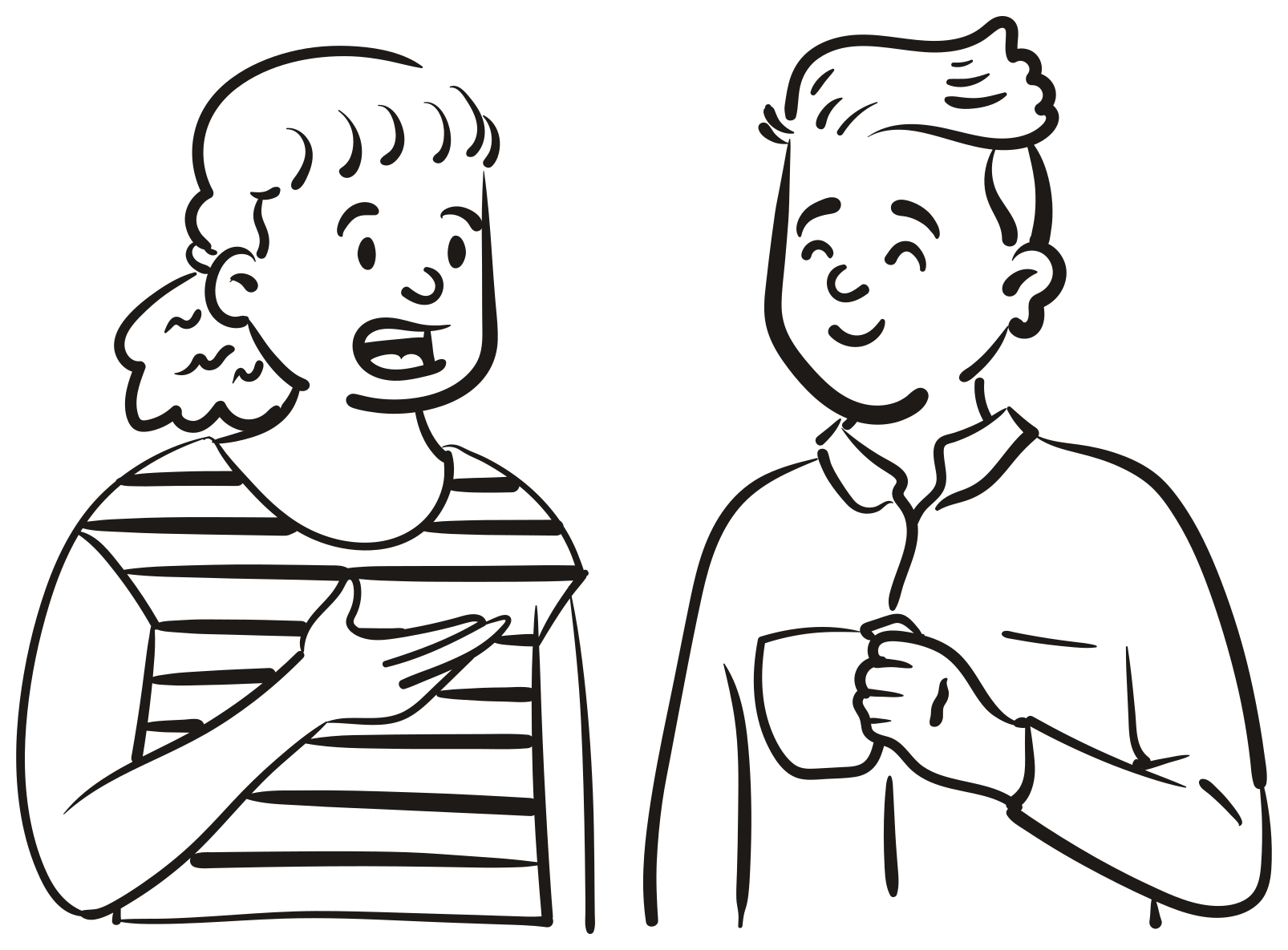
01:10 is the hour of drives that fall into step: listen before you decide, and let the other person finish their sentence.
This is the moment to align two close wills rather than set them against each other.
Attentive listening, which calms disagreements.
Cutting the other person off, or always being the first to give in.
By Thomas Guilhot · updated
Read backward as well as forward, this time would be for tradition the image of a back-and-forth: an idea sent out and sent back, inviting you to check whether it still looks like you.
On the screen, 01:10 reads like a small symmetrical word: two zeros hold the edges, two 1s touch at the center. The hour and the minutes swap their digits without losing anything, and each of the two halves is worth 1. The calculation is short: 0 + 1 + 1 + 0 = 2. No reduction is needed.
This step from 1 to 2 is what makes the hour interesting. Alone, a 1 moves forward without asking permission and decides for itself. Put a second one right beside it, and the question changes in nature: it is no longer only about what you want, but about how that fits with what the other person wants. The 2, for its part, listens, looks for agreement, and senses what the other person feels. At 01:10, this 2 is born from two wills pressed against each other, with no space between them.
The moment matters too. Ten past one in the morning is when you come home from an evening out, when you sit up with a child, when a conversation stretches on instead of ending. Nothing here is public: whatever happens happens between two people, or in a private face-to-face with yourself.
Its twin, 10:01, turns the figure around: the 1s move to the ends and the zeros open a gap in the middle. Same total, different distance. If 01:10 stops you, the question it raises is one of closeness: do two drives that are very near each other reinforce one another, or get in each other’s way?
As a couple, 01:10 recalls what happens when each of you arrives with a ready-made solution.
Picture a Sunday evening: one of you has already booked the weekend, the other had promised a visit to their parents. Neither is wrong, and yet the evening gets tense. The 2 leaves you your drive; it only suggests putting it on the table before turning it into a done deal. A question to ask yourself: what have you settled on your own lately that also committed the other person?
Without a relationship, the two 1s stuck together in the middle of 01:10 suggest a life that is already full, arranged your way, where another person would have to make room.
The 2 invites you to look at how you let people come close: do you offer a coffee at a set time, squeezed between two obligations, or do you accept that an evening may stretch on without knowing when it will end? Choosing someone also means accepting that they will disrupt your schedule a little. What would you be willing to move?
Two 1s side by side suggest a pairing of two strong personalities: two partners, two managers who share a department, two colleagues given the same file.
The energy is there, and so is the friction. The resulting 2 suggests looking at how you cooperate when you are attached to your own method. Can you delegate part of a project without taking everything back afterward? Do you ask a colleague’s opinion before launching an idea, or only afterward? In a meeting, can you restate someone else’s proposal before defending your own? These small habits say a great deal about how you work as a team.
When it comes to money, the two 1s side by side in 01:10 suggest expenses decided alone that actually involve two people: a big purchase paid from the joint account, a subscription taken out without mentioning it.
The 2 invites you to lay the numbers out together. Which recent expense would you have been better off announcing before making it?
The same digits the other way around: the two halves swap places, and the total stays 2.
The angel Elemiah, tarot card 1, and the message as tradition reads it.
Elemiah
The Kabbalistic tradition gives each of its 72 angels twenty minutes of the day: 01:10 falls within those of Elemiah, the 4th.
The Magician
The reading of hours links 01:10 to the card that bears the hour’s number, 1.
The meaning you find in it is up to you. Read the profile of Elemiah, or see the 72 guardian angels.
Two readings can coexist: the symbolic reading and the attention reading.
For many people, seeing 01:10 again is a synchronicity in Jung’s sense: a meaningful coincidence, which tradition reads as a message.
Of the 1,440 minutes in a day, 01:10 takes up only one, two on a 12-hour display: a doubled time sticks in the mind, and once you have noticed it, you watch for it. It is up to you to see which one speaks to you, or both.
If 01:10 keeps coming back, write down next to the time the name of the person you were thinking of at that moment.
After a few weeks, reread the list: it shows with whom a question of agreement is still open.
The mirror hours and angel numbers made of the same digits, and the number they repeat.
01:10 · reversed hour
01:10 is the hour of drives that fall into step: listen before you decide, and let the other person finish their sentence.
0 + 1 + 1 + 0 = 2 · How to read a mirror hour
A time is read through its digits, its two halves, and its total: add the four digits, then reduce to a single one (11, 22, and 33 stay whole).
The same digit 2 times: the reading dwells on it.
01 and 10 both reduce to 1: the same number, with the digits in another order.
This number gives the time its main reading.
0 + 1 + 1 + 0 = 2
01:10 gives 2: you add 0, 1, 1, and 0. In this reversed hour, the two halves each reduce to 1. It therefore combines the independence of the 1 twice with a total that speaks of listening and cooperation. In other words, it asks how two close wills find common ground, without hinting at anything about what comes next.
Both hours have the same digits, the same total, 2, and the same halves, two 1s. Only the arrangement changes. At 01:10, the two 1s touch in the center, in the middle of the night: a closeness that can bring people together or cause friction. At 10:01, they are at the ends, separated by two zeros, in the middle of the morning: a distance to cross between two people.
You can hold two explanations at once. On the symbolic side, people speak of synchronicity, Jung’s word for a coincidence charged with meaning, which many receive as a message. On the everyday side, insomnia, a late return, or a crying baby put your eyes on the screen at that moment, and a symmetrical sequence is easier to remember. In both cases, use it as a landmark: who were you with, and what were you thinking about?
Two 1s that end up as a 2: two independent lives seeking to meet. Without a partner, observe how you approach someone. Are you waiting for your life to be fully organized before letting another person in? The 2 does not ask you to give up your independence, but to accept that a bond is also built with the unexpected. In the middle of the night, a simple question: who would you like to tell your ideas to?
Some readings see in a symmetrical hour a bond of the mind tied between two people; it cannot be confirmed for anyone in particular. Night, however, often brings back those we miss. The two 1s of the hour, face to face, describe two people each waiting for the other to take the step. If a name comes to you, write it down and ask yourself what keeps you from writing to them.
Written 0110, or 110 without the leading zero, the number keeps its digits and its total: 1 + 1 + 0 = 2. Some readings of repeated numbers hear an echo of the hour in it, a reminder of the same theme. The calculation, for its part, finds there the agreement between two neighboring wills, and it does not change; it is up to you to put in the meaning that suits you.
According to followers of the guardian angels, the day is divided into 72 slots of twenty minutes, each placed under one of the angels drawn from the Kabbalah; a symmetrical hour that forces itself on your gaze would mark that angel’s presence. The angel card, above, gives the name. The calculation sits alongside this reading, with the 2 of listening. Welcome both together, or keep only one.
Tap a time to read its meaning.
