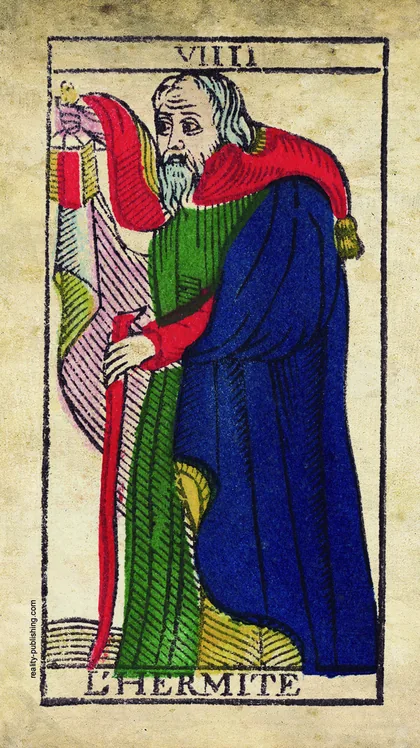
With the Hermit, the couple feeds on dialogue: you love depth and a presence that respects your withdrawals.
deep dialogue
chosen solitude
meeting of minds
The essentials
Arcana 9 in love and relationships at a glance
A strength
You bring a rare quality of listening to the couple. Long conversations, shared reading, and questions that go deep find their place there, and your partner discovers that one can confide without fearing judgment. Your calm gives perspective in stormy episodes, and your fidelity rests on meaning, not habit.
Something to watch
Withdrawing without warning can read as distance. When you isolate yourself to think, your partner wonders what happened. A few words are enough: “I need a few hours, I’ll be back.” Announcing the pause keeps it from taking the form of a silence the other has to decipher.
In a couple, the 9 looks for a partner with whom to talk about everything for hours.
The person who suits you has read, traveled, reflected; they have their own inner life and do not worry when you need an entire evening immersed in a novel. The choice is made slowly, and commitment often comes late, but it lasts. What makes it last: study or travel projects for two, sincere conversations, respect for silences. What damages it: idealizing the other and then judging them harshly, staying quiet instead of naming a hurt, letting mistrust suspect everything.
On the partner side, the Hermit describes a cultured, curious person with an inner life of their own, serene enough not to worry about your moments of solitude. Mind charms you more than appearance, and a deep exchange more than a noisy evening. You are drawn to the person who has read, seen, and thought a lot.
In the karmic tail, the Hermit stands for withdrawal, according to the method: having protected yourself by staying silent, having kept your distance out of caution, having felt love as a risky exposure. The reading invites you to let the other approach, in stages, without defending yourself in advance.
On the point shared by money and relationships, the Hermit argues for chosen simplicity: a plain life, considered spending, projects that have meaning before they have value. It suggests saying out loud what matters materially, so that one person’s simplicity does not pass for a renunciation imposed on the other.
The Hermit in your life
In everyday life
After a busy week, you feel the need to retreat to the back room with a book.
Rather than disappear, you give notice: two hours, then you join your partner for dinner. At the meal, you tell about a passage you read, an idea that struck you. The other answers with their own thought. The evening runs late, and time alone has fed time together, far from any reproach. Announcing the pause was enough to make it welcome.
What helps
What helps
Announce a time of withdrawal and the time you will be back
Reserve a screen-free conversation each week, with no agenda
Share a reading, an idea, or a memory rather than keeping your thinking to yourself
The Hermit, love and relationships: nuances
Where it sits in the matrix
These points: partner point, karmic tail (entry), crossroads point.
Partner point
What attracts you to a partner, what opens the heart.
Karmic tail (entry)
The first number of the karmic tail, the one closest to you.
Crossroads point
The point where money and relationships meet.
A symbolic reading of the Destiny Matrix: food for thought about yourself, never a verdict or an established fact.
Everything starts with the life lesson, the sum of the portrait, the talent, and the material point.
For the example date, March 14, 1987, you get 24, reduced to 6. The relationship entry point adds the center to this 6: 6 plus 3 makes 9, the Hermit. On the money side, the material point 7 and the center give 10. The crossroads adds these two entry points, 10 and 9, making 19, the Sun. The partner finally comes from the relationship entry point and the crossroads: 9 and 19 make 28, reduced to 10, the Wheel of Fortune.
Frequently asked questions: arcana 9 in love and relationships
Does the Hermit in love condemn you to solitude?
No, it describes a need for calm that coexists very well with a deep bond. Many with this energy live in lasting couples, provided their way of withdrawing is understood. When your partner knows that solitude is a way of recharging, it stops looking like abandonment.
How do you get your need for withdrawal across without hurting anyone?
By phrasing it as a need, never as a reproach. Say what you plan to do, for how long, and what you would like to find afterward. When the withdrawal is announced and limited, nothing invites a search for its cause. It can even pass for a sign of trust rather than distance.
Does a very sociable partner suit this energy?
It is possible, with mutual respect for rhythms. A sociable person can offer openings onto the world, while you bring depth and calm. The key is not to see these differences as flaws, and to plan shared moments that suit both sensibilities, without one imposing itself.
Illustrations: Nicolas Conver’s Tarot de Marseille, dated 1760, restored by Tarot World Project, CC BY-SA 4.0 license, via Wikimedia Commons — images resized and compressed by Versana.