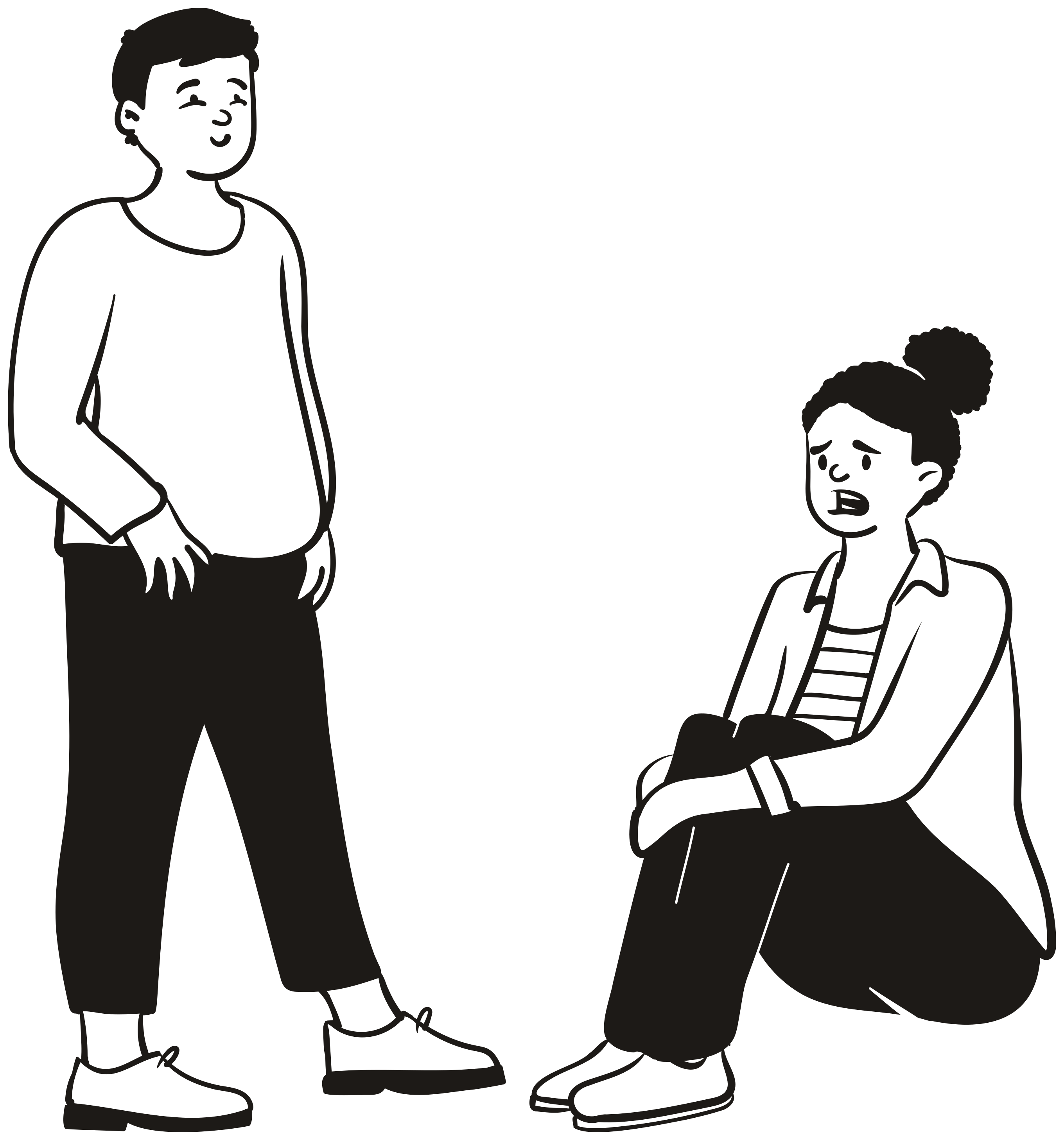
On the path of 6, relationships sit at the center: home, family, loved ones, with one constant question, knowing what is yours to carry and what is not.
For a life path 6, this thread runs through relationships. Very early, many 6 people find themselves in a support role: looking after siblings, receiving the family’s confidences, acting as the link, from adolescence, between separated parents. Later, this pattern can take other forms: an aging parent you support because you live closest, a friend in the middle of a storm who finds refuge on your couch.
The road of the 6 is the road of responsibility. Step by step, it poses the same question: what am I truly responsible for, and what am I not? In the first part of life, the answer commonly leans toward “everything.” You accept, you carry, you arrange. With the years, path 6 learns to tell apart the commitment you choose from the one you endure, and to say no without guilt.
This course also involves a large share of building: starting a home, choosing a house and transforming it, building a team or an association that lasts. The major milestones of a path 6 commonly take the form of moves, commitments, reconciliations. Beauty has its place here: arranging a space, harmonizing a living environment, making a house a place where you want to come back.
The maturity of a path 6 shows in one precise quality: knowing how to help without taking control. Supporting a loved one while letting them decide, holding your place in the family without becoming its only pillar.
Qualities and downsides
Qualities
Keeping a commitment for years, where others would have let go.
Calming a family quarrel by listening to both sides.
Turning an empty place into somewhere people want to stay.
Inspiring enough trust that people leave you the keys.
Downsides
Putting a personal project off, year after year, for the family.
Becoming indispensable, to the point of no longer being able to be away.
Maintaining a façade of peace around the table.
Confusing supporting a loved one with deciding in their place.
Others give up a commitment at the first obstacle; you stay, you look for a solution, you mend.
This constancy earns you a trust that is rarely granted: you are entrusted with children, keys, secrets, a shared budget.
Path 6 also develops a talent for mediation. The family or group trials you have gone through teach you to listen to both sides and find common ground. Over time, you become the person who can calm a conflict without smothering it. Your sense of home, finally, is a real resource: you know how to turn an empty apartment, a community hall, or a meeting room into a place where people feel expected.
Points to watch
The main risk is building your life around other people’s needs, until you lose sight of what you would have chosen for yourself.
A path 6 may turn down a transfer, a trip, or a training course “because it’s not the right time for the family,” and repeat that sentence for fifteen years.
The feeling of being indispensable also lurks. It flatters, then it confines. If everything goes through you, nobody learns to manage on their own, and you can no longer be away. Another slope: path 6 sometimes pushes toward keeping up a façade of harmony. You avoid the touchy subject at the Christmas dinner, you accept an unfair situation to avoid making waves. Yet a tension passed over in silence may come back, no weaker than before.
Life path number 6 in your life
In love
For a life path 6, emotional life holds a central place, and it is lived mostly as commitment: moving in together, a plan for a child, a blended family to hold together.
You look for a partner to build with, not only to share intense moments with.
The course regularly brings you the same lesson: loving does not mean managing everything. The calmest relationships, for a path 6, are those where roles are truly shared, where the other also takes initiative for the household. According to the harmony table, the 6 finds natural affinities with four paths, 1, 3, 5, and 9, which reflect back drive, cheerfulness, openness, or idealism: these are paths to rapport, never conditions.
At work
Path 6 may find its calling in the people-centered professions: teaching, supporting, welcoming, advising, designing living spaces.
Special education worker, elementary school teacher, or interior decorator come to mind, but a calling can also live in an administrative job, as long as it has a service dimension.
What matters is the human meaning of the activity and the quality of the atmosphere. A well-paid but cold job, where you do not know your colleagues, ends up weighing on you. Conversely, a close-knit team makes up for a lot. Over the course of the path, many path 6 people take on management responsibilities almost despite themselves: they are given a team because they were already looking after it.
Life path number 6: nuances, tradition, and advice
The calling, according to tradition
For the numerological tradition, the mission of life path 6 comes down to one word: responsibility.
Authors see in it a life called to bring harmony around itself, in a home, a community, or a workplace, and to discover what it means to answer for someone. According to this reading, the point is not to carry everything, but to love while leaving the other free, and to make exchanges between people fairer. Some texts add care for everyday beauty, that of a house or a table. The tradition speaks of learning, not of an assigned role; this portrait stands as a lead to test against your own story.
In everyday life
On a life path 6, you may find yourself picked by default for the tasks that commit you.
The Christmas Eve dinner may be held at your place, and the school thinks of you when the parents’ meeting is short of volunteers. At the office, the file of a coworker on parental leave may fall to you; in your building, you probably keep the keys of three neighbors.
These situations are not repeated coincidences: they make up the learning ground of path 6. Each one asks the same question in a different guise: how far to go for others, and when to hand things back?
Money and security
For a life path 6, money first serves the home: a decent roof, a table where you can invite people, shared vacations.
An activity with meaning generally comes before the salary, even if it means earning less than elsewhere. Your spending goes in large part to others: the thoughtful gift, your share of a parent’s rent, the loan to a brother that is half repaid. The road teaches you to separate generosity from obligation: set the amount you can lend without regret, keep savings in your own name, and talk budget as a couple without seeing in it a lack of trust.
If you don’t recognize yourself
A life path 6 may feel very far from this description: little appeal in family life, a strong need for independence, even irritation at obligations.
This is common. A life path indicates a learning ground, not something already acquired. You may be living the lesson from the other end: by fleeing responsibilities that were imposed on you too early, or by still searching for which commitment suits you. The rest of the chart, the Expression number and Soul Urge number first among them, also colors strongly the way this 6 is lived.
Which careers suit a life path number 6?
Family mediator, community center manager, interior architect.
Family mediatorhelping two sides talk again without deciding for them
Community center managerkeeping alive a place where everyone finds a role
Interior architectadapting a home to the lives of those who live in it
A tip
Take stock of what you took on this month: appointments, errands, other people’s worries.
Next to each line, write “chosen” or “endured.” Start by lightening one line marked “endured.”
A life path 6 thrives in activities where you serve, support, or welcome: education, care, counseling, designing living spaces, community life. Teacher or interior architect suit this profile. What matters is a warm team and the feeling that your work helps someone.
Which life paths is 6 compatible with?
The harmony table links path 6 with paths 1, 3, 5, and 9. With these numbers, rapport is in principle built more easily. Other pairings work very well, provided you talk about it: a 6 and a 7, for example, have to reconcile their taste for connection with their taste for solitude.
Life path 6 or 33: how do you tell the difference?
It all depends on the calculation. If adding the digits of your date gives exactly 33, you have a life path 33, which is also read as a 6. If it gives 15, 24, or 42, it is a plain path 6. The page devoted to 33 details what this master number changes.
What is the weakness of a life path 6?
The most common failing is carrying too much: taking on everyone’s worries, then wearing yourself out or keeping a silent resentment. Next comes the slide from help into control, when you know better than others what suits them. As for the taste for peace, it can make you avoid necessary conversations. These are the excesses of a real quality, not a flaw of character.
Does a life path 6 have to have children?
No. Path 6 speaks of responsibility and care, and these themes are lived in many ways: with a parent, students, a team, a neighborhood, animals, a place you look after. Many 6 people without children find their place fully in teaching, nonprofit work, or hospitality. The number describes a learning ground, never an obligation in life.
Is life path 6 common?
It is one of the ordinary life paths. None of the values from 1 to 9 clearly dominates in the population; only the master numbers, which require a specific addition, are rarer. Some of the dates that would give 6 also end up at 33 when the digit-by-digit addition lands on that total. Being common or uncommon makes a path neither better nor less interesting.
Your calculation
Calculate your life path number
Is this really your life path number?
Life path number 6 with the other life paths
Each pair has its own compatibility page: what brings you closer, what calls for adjustments.
1Life paths 6 and 1HarmonyCompatibility of 1 and 6 is a warm harmony: the one who charges ahead and the one who cares, if daily life stays shared.
2Life paths 6 and 2Contrast2 and 6 compatibility is an affectionate contrast: two numbers turned toward others, who have to learn to ask.
3Life paths 6 and 3Harmony3 and 6 compatibility is a harmony: one brings joy to the bonds, the other makes sure they hold.
4Life paths 6 and 4Contrast4 and 6 compatibility is a contrast: two serious, devoted people, one thinking first of organization, the other of people.
5Life paths 6 and 5HarmonyCompatibility of 5 and 6 is a harmony of balance: a need for movement and a need for home, which complement each other.
6Life paths 6 and 6AccordCompatibility of 6 and 6 is a warm match: two people attentive to others and attached to home, who leave room for each other.
7Life paths 6 and 7ContrastCompatibility of 6 and 7 is a contrast: one turned toward loved ones, the other toward reflection, rich if each respects the other.
8Life paths 6 and 8ContrastCompatibility of 6 and 8 is a contrast: two builders with different priorities, loved ones for one, goals for the other.
9Life paths 6 and 9HarmonyCompatibility of 6 and 9 is a generous harmony: one watches over their own, the other looks further out.